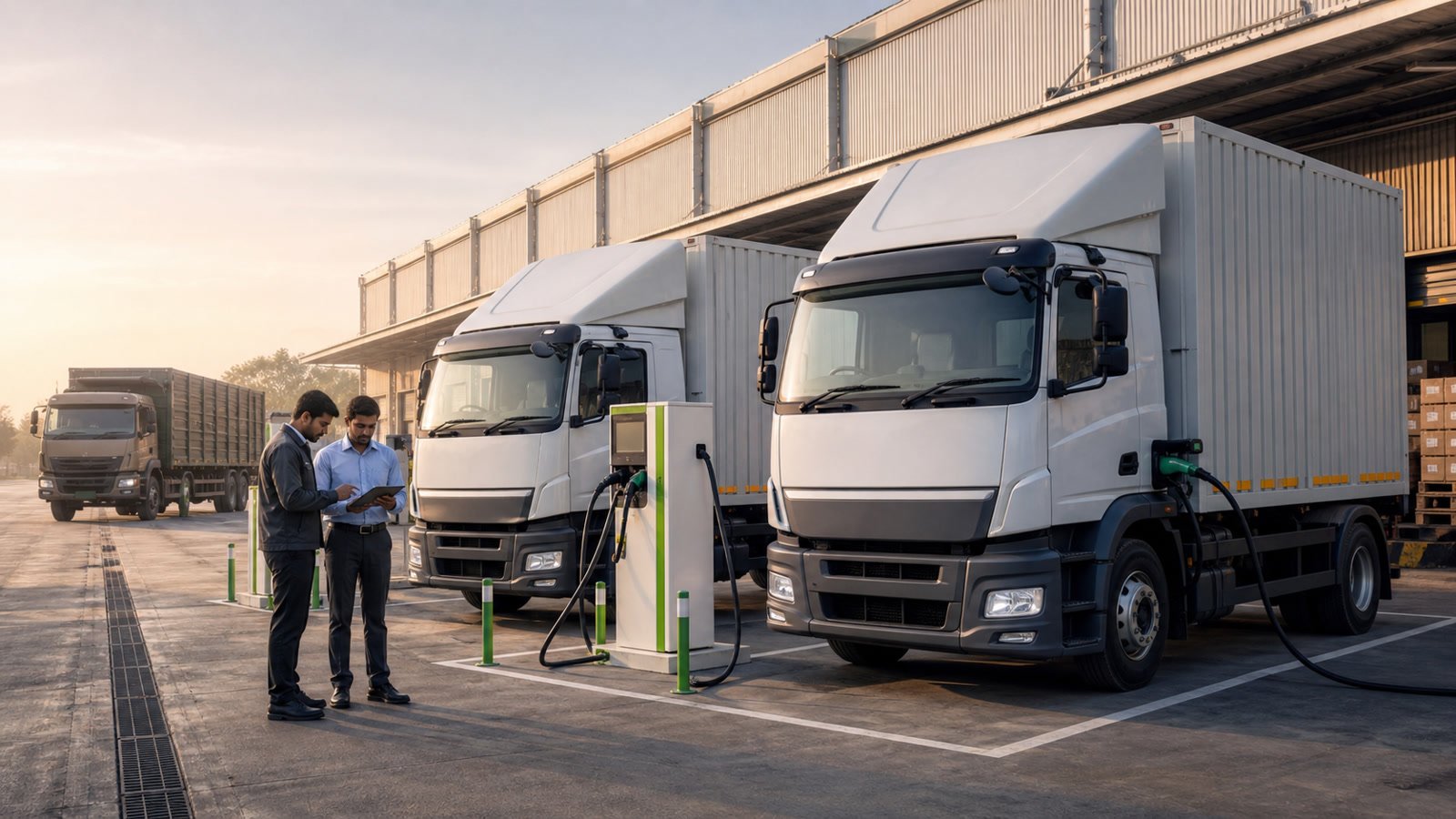
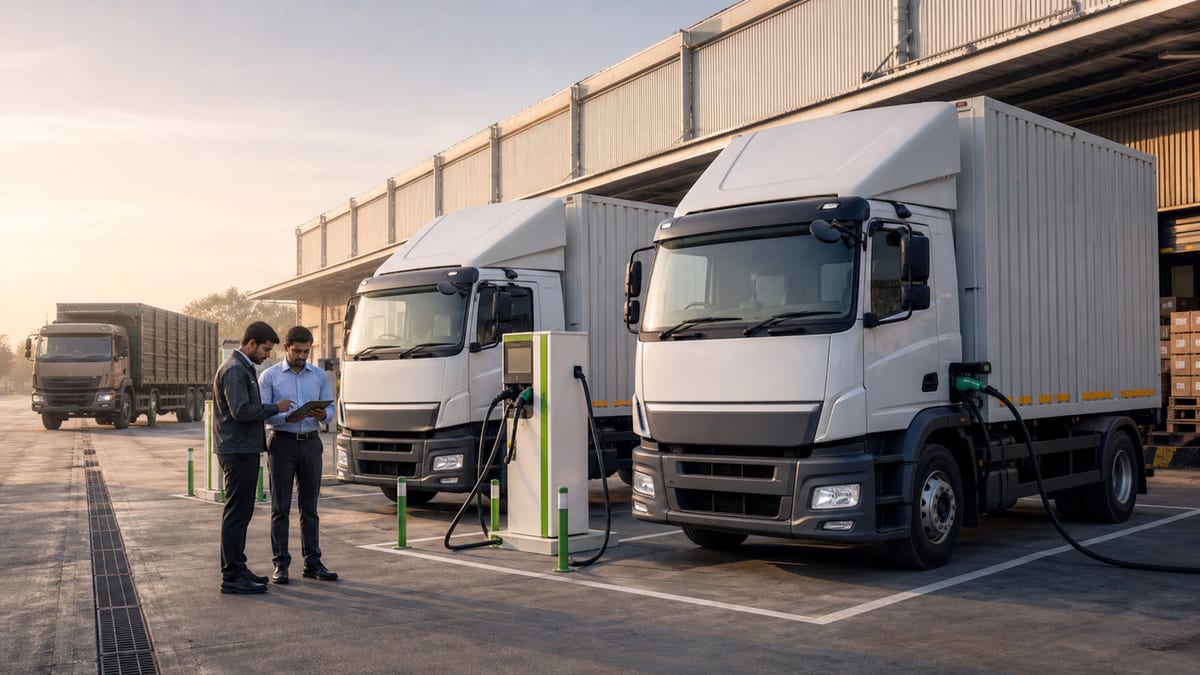
India's large industrial companies are moving faster on electric trucks as diesel volatility, rising logistics expenses and sustainability targets change the economics of freight. Economic Times reported on June 13, 2026 that major corporates are accelerating investment in e-trucks as they reassess conventional diesel-led transport models. For FuelPrice readers, this is not just a clean-mobility headline. It is a fuel-cost story because diesel remains the backbone of Indian freight, and every shift in high-mileage trucking has a direct link with transport cost, supply-chain planning and long-term fuel demand.
The important change is that e-trucks are no longer being discussed only as trial vehicles for public-relations value. They are increasingly being tested on defined industrial routes where the payload, distance, charging window and depot control are predictable. That makes the corporate shift more practical than a broad promise to electrify freight overnight. Heavy freight is hard to electrify, but some use cases are now clear enough for companies to build operating models around them.
Sponsored
What Has Changed
The earlier freight model was simple: companies hired or owned diesel trucks, passed some fuel pressure into freight contracts, and treated volatility as part of doing business. That model becomes harder when diesel costs rise, logistics expenses remain elevated, and large customers demand cleaner supply chains. Electric trucks offer a different cost profile: higher upfront cost, lower energy cost on suitable routes, lower tailpipe emissions, and the possibility of depot-based charging discipline.
The June 13 ET report frames the current shift around India's biggest industrial companies. The common trigger is not one single subsidy or one single truck model. It is a combination of diesel uncertainty, corporate sustainability commitments, and a search for better freight economics. That combination matters because it creates demand from the customer side of logistics, not only from vehicle makers.
Why Diesel Users Should Pay Attention
Freight users often look at diesel prices only when rates move sharply at the pump. But large shippers feel diesel pressure in a broader way: freight contracts, escalation clauses, route buffers, idle time, vehicle availability and working-capital cycles. A high-mileage diesel truck can consume enough fuel for even small per-litre changes to affect monthly operating cost. When many trucks move cement, steel, minerals, consumer goods or industrial inputs, the impact becomes a supply-chain line item.
Electric trucks do not remove all those costs. They replace one set of risks with another. The operator must solve charging location, charger uptime, route range, payload impact, battery warranty, driver training and financing. But if a route is repetitive and depot-controlled, the fuel-cost comparison becomes more favourable. That is why industrial corridors, mining routes, port movement, cement logistics and factory-to-warehouse freight are more realistic early markets than open-ended long-haul trucking.
| Decision factor | Diesel truck model | Electric truck model |
|---|---|---|
| Energy cost | Exposed to diesel price volatility and freight escalation. | Depends on electricity tariff, charger efficiency and route planning. |
| Uptime | Fast refuelling, mature service network. | Works best with planned depot charging and reliable charger availability. |
| Capital cost | Lower upfront cost in most segments. | Higher upfront cost, partly offset by incentives and operating savings where route fit is strong. |
| Best early use case | Flexible long-haul and uncertain routes. | Repetitive industrial, port, mining, factory and urban freight routes. |
Policy Support Is Helping The Economics
The corporate push also has policy support. In July 2025, the government launched incentives for electric trucks under the PM E-DRIVE initiative. Times of India and Economic Times both reported that the scheme offered support of up to Rs 9.6 lakh per electric truck, with Rs 500 crore earmarked for e-truck incentives within the wider Rs 10,900 crore PM E-DRIVE programme. TOI also reported that Steel Authority of India Limited planned to procure 150 e-trucks, giving the segment an early public-sector demand signal.
That incentive does not make every e-truck automatically viable. It reduces part of the upfront gap. The rest must come from route economics: kilometres run per day, load factor, electricity cost, maintenance, charging downtime and vehicle life. Fleet buyers will not shift at scale unless the total cost per tonne-kilometre is defensible.
Vehicle Makers Are Building Use Cases, Not Just Products
The supplier side is also becoming more specialised. Times of India reported earlier this year that Murugappa Group's Tube Investments of India planned another Rs 500 crore to Rs 750 crore investment to scale its EV business through TI Clean Mobility. The report said the company operates across electric three-wheelers, small commercial vehicles, medium and heavy commercial vehicles, and electric tractors. It also reported 56 electric heavy-truck sales in the December 2025 quarter and more than 40% market share in the electric heavy-truck segment, with cement logistics named as a segment-specific use case.
That detail is important. Electric heavy trucks cannot be sold like generic passenger cars. A cement route, mining haul, port container movement or factory shuttle has different payload and charging requirements. The winning business model will likely combine vehicle, charger, financing, route study, maintenance and energy management. Corporate buyers are not only buying a truck; they are buying a new operating system for freight.
Who Is Affected First
- Large manufacturers: They can reduce exposure to diesel volatility on predictable routes and improve emissions reporting.
- Logistics contractors: They may need to invest in e-truck fleets if anchor customers start demanding cleaner freight.
- Diesel fleet owners: Older cost assumptions may change where e-trucks prove cheaper on high-utilisation routes.
- Fuel retailers: Diesel demand will not disappear soon, but depot charging can gradually take share in select freight clusters.
- Consumers: Any reduction in logistics cost volatility can eventually help stabilise supply-chain pricing, though the effect will be gradual.
What To Watch Next
The next phase will be decided by utilisation data, not announcements. Watch how many e-trucks are deployed on actual freight routes, whether they meet daily tonne-kilometre targets, and how often chargers are available when trucks return to base. Also watch whether customers pay a premium for cleaner freight or demand cost parity from day one.
Battery warranties, residual values and financing terms will be equally important. A diesel truck has a mature used-vehicle market and a known repair ecosystem. Electric trucks need stronger confidence around battery life, charger standards and resale value. If lenders become comfortable with these risks, adoption can accelerate. If financing remains expensive, corporate pilots may take longer to become mainstream fleets.
The reader takeaway is direct: electric trucks are becoming a serious freight-cost option where diesel volatility hurts and routes are predictable. They are not yet a universal replacement for diesel long-haul movement, but they are moving into the parts of logistics where companies can control charging, measure savings and report cleaner operations. For fuel users, this is an early signal that diesel demand in some industrial freight pockets may face gradual but real competition from electricity.
Sources: Economic Times corporate e-truck report, Times of India PM E-DRIVE e-truck incentive report, Economic Times PM E-DRIVE e-truck incentive report, Times of India TI Clean Mobility context.