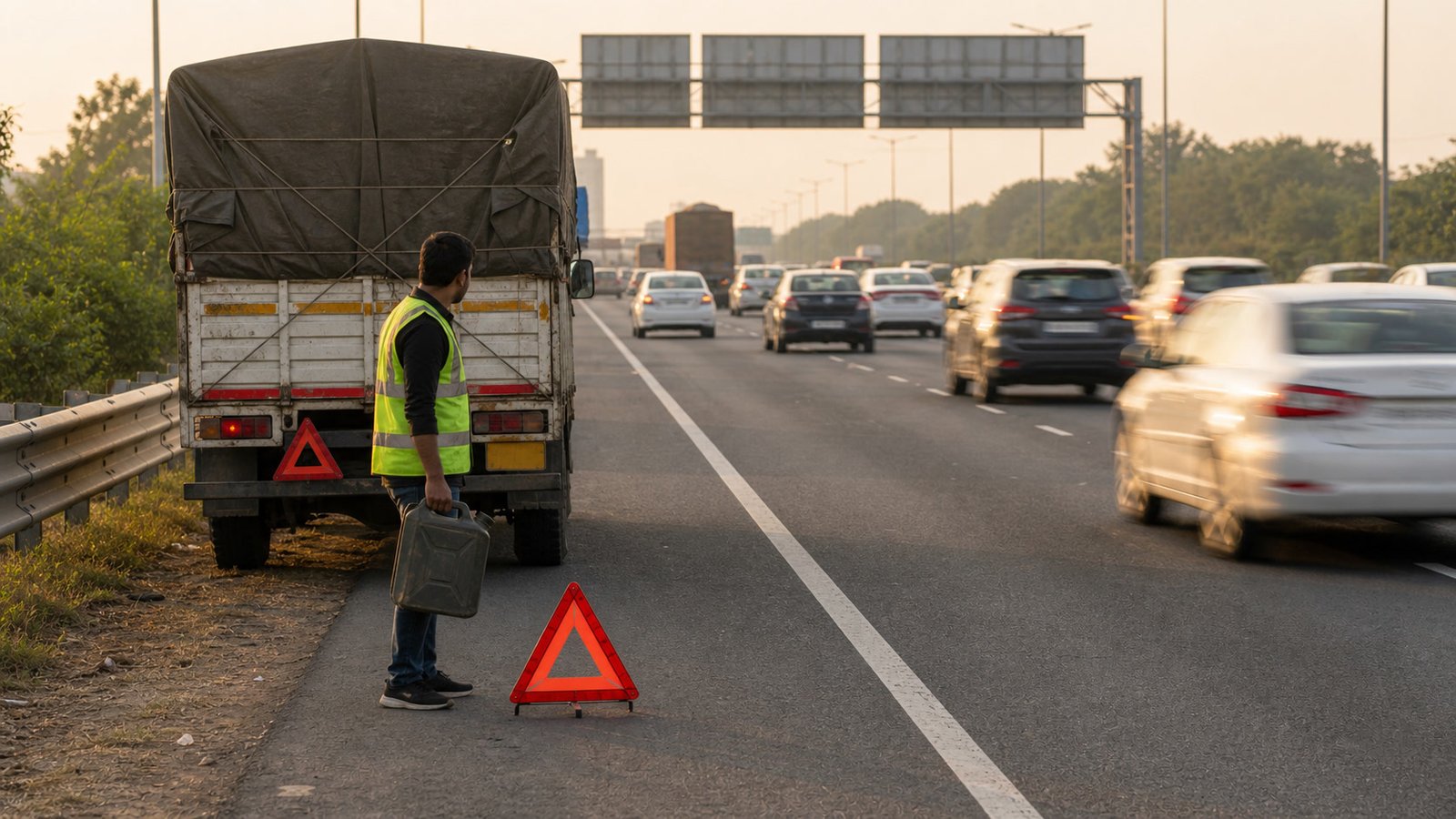
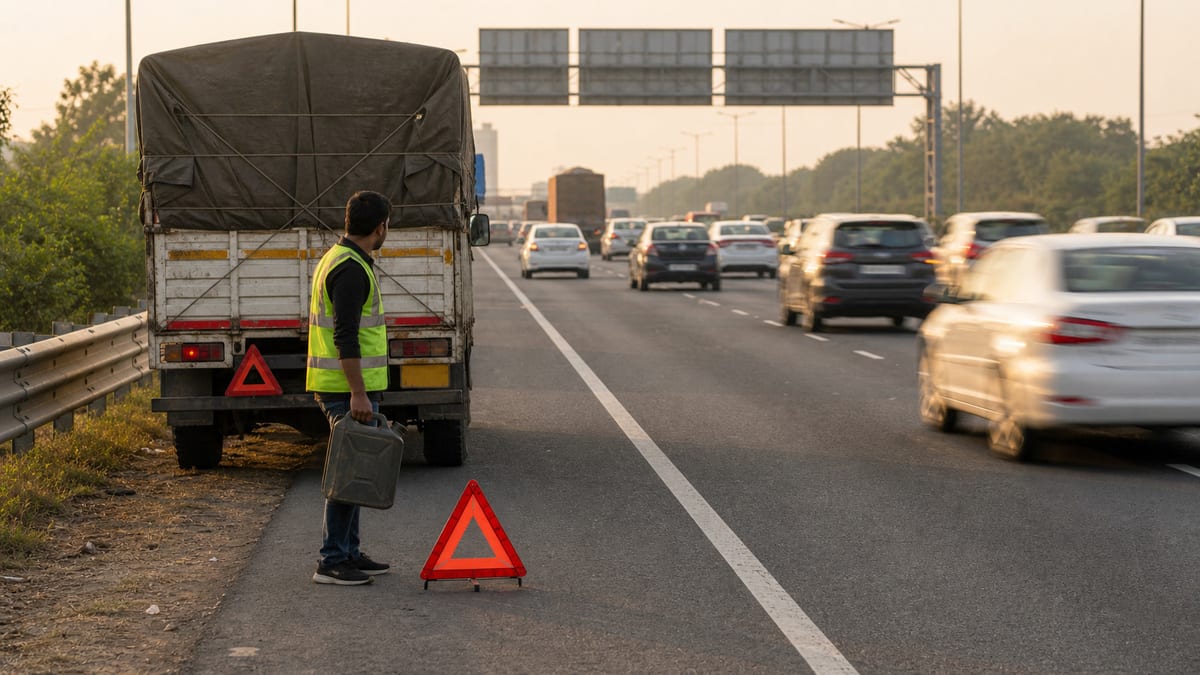
A truck driver's death on the Delhi-Gurgaon Expressway has turned a routine freight problem into a stark safety warning. Times of India reported on June 14, 2026 that the driver, whose vehicle had run low on fuel near Pachgaon Chowk in Manesar, stepped out to fetch diesel and was killed in a hit-and-run while trying to return. As reported by TOI, the collision happened on Thursday, June 11, 2026, and the driver was from Alwar district in Rajasthan.
For FuelPrice readers, this is not just an accident brief. It is a freight-and-fuel story with a hard operational lesson. A truck that runs short of fuel on a high-speed corridor does not simply stop working. It creates a chain of risk: an exposed vehicle on the shoulder, an exposed driver on foot, fast traffic with limited reaction time, and possible knock-on disruption for other heavy vehicles. On one of NCR's busiest expressway links, even a short roadside fuel emergency can turn into a fatal event.
Sponsored
What happened and why it matters
The reported trigger was basic but consequential: a heavy vehicle short on fuel. According to TOI, the driver had parked the truck and gone to arrange diesel when an unidentified vehicle hit him. That detail matters because it shifts the discussion from reckless driving alone to a wider highway operations problem. When truckers have to leave a stranded vehicle and move on foot near a live carriageway, the corridor becomes dangerous in a way that is preventable.
High-speed expressways are engineered for flow, not for pedestrians or unplanned roadside stops. A truck parked on the shoulder may still be within the visual path of fast-moving cars, buses and other goods vehicles. The driver, especially in low light or under stress, becomes the most vulnerable part of the incident. In freight terms, the cost is larger than one vehicle delay. It can mean lost cargo time, disrupted schedules, emergency response pressure and heightened danger for any crew member trying to solve a fuel or breakdown problem without proper protection.
Why this corridor deserves attention
The Delhi-Gurgaon Expressway is not a minor road. TOI reported on June 13, 2026 that nearly 3 lakh passenger car units use the corridor daily and that an ongoing upgrade between Shankar Chowk and the Delhi-Jaipur Expressway has already come under scrutiny from NHAI for slow progress and poor on-ground execution. That means any roadside emergency on this stretch unfolds in a traffic environment that is both dense and fast.
Importantly, the upgrade story should not be treated as the proven cause of this fatal incident. The available reports do not establish that link. But the broader context still matters. When a corridor is carrying extremely heavy daily movement and is simultaneously facing construction, surface problems, bottlenecks or incomplete traffic management, the safety margin for stranded commercial vehicles becomes thinner. The trucker death is therefore best understood as a high-consequence event on a corridor already under pressure.
| Risk point | Why it becomes dangerous | Who feels the impact |
|---|---|---|
| Truck running low on fuel | Driver may stop on shoulder or leave vehicle to source diesel | Driver, co-driver, passing motorists, cargo owner |
| Shoulder-side parking on expressway | Fast traffic leaves little recovery time if a person is on foot near live lanes | Heavy vehicles, passenger cars, patrol teams |
| Poor surface or bottleneck conditions nearby | Driver attention is already split by uneven flow, lane changes and slower sections | Entire traffic stream on the corridor |
| No immediate safe assistance point | Problem-solving shifts from managed response to risky improvisation | Truckers, fleet operators, emergency responders |
The maintenance and visibility backdrop
Other recent reporting from the same corridor strengthens the larger safety concern. In March 2026, TOI reported that NHAI had formally criticized poor upkeep at the Sirhaul toll plaza on the Delhi-Gurgaon Expressway. The authority flagged potholes, uneven road surfaces, dust and dirt accumulation, and inadequate retro-reflective markings that reduce night-time visibility. Those issues were linked to one of the busiest entry points between Delhi and Gurgaon.
Separately, TOI reported in January 2026 that the Kherki Daula toll service road had deteriorated again just weeks after repairs, with loose gravel, broken surfaces and heavy truck movement worsening conditions. Again, these stories do not prove a direct link to the June 11 fatality. But they do show a recurring pattern on the corridor: freight-heavy traffic, damaged or uneven road elements, and a highway environment where a stopped truck or a driver on foot can quickly become part of a larger safety failure.
Why this matters for truckers and fleet operators
For truck drivers, fuel planning is not always as simple as it sounds from an office desk. Delays at loading points, route diversions, unexpected congestion, long queues, low-cash situations, dispatch pressure and last-minute changes can all alter where a driver expects to refuel. But on expressways, the buffer for error is much smaller. Once a truck is immobilised near a live carriageway, the question is no longer just fuel cost. It becomes a question of survival.
Fleet operators should treat this incident as an operational warning. A low-fuel event on a high-speed corridor should trigger an emergency-assistance protocol, not an individual driver's improvised walk to source diesel. Companies moving freight through the NCR belt should review minimum fuel-departure thresholds, GPS-linked fuel alerts, emergency contact escalation, safe pull-off instructions, and the availability of roadside assistance or recovery vans. Those costs are small compared with the human and legal cost of a fatal roadside incident.
Who is affected beyond one truck
- Truck drivers: they face the direct physical danger of leaving a vehicle on a high-speed corridor.
- Fleet owners: every roadside fuel or breakdown event can mean cargo delay, liability exposure and reputational damage.
- Commuters: stopped heavy vehicles and emergency activity reduce lane discipline and increase sudden braking risk.
- Highway agencies: repeated shoulder-side incidents raise pressure to improve incident response, visibility, and maintenance discipline.
There is also a labour angle. Driver safety is part of freight reliability. If truckers see certain routes as unsafe in breakdown or low-fuel situations, it affects morale, turnover and the willingness to accept tighter trip schedules. In that sense, this is a logistics productivity issue as much as a road safety issue.
What should change now
The most immediate change should be procedural. Operators need stricter fuel buffers before vehicles enter high-speed urban corridors. Drivers need clearer instructions that stepping into or crossing live expressway traffic for fuel should never be the default solution. Emergency triangles, reflective jackets and shoulder protocols help, but they are secondary. The real objective is to stop roadside fuel improvisation from happening at all.
On the infrastructure side, the corridor needs stronger visibility and maintenance discipline wherever heavy vehicles are likely to slow, queue or divert. NHAI's own inspection concerns at Sirhaul show that housekeeping, surface quality and retro-reflective markings are not cosmetic matters. They directly affect how quickly motorists detect hazards. On a corridor carrying nearly 3 lakh PCUs a day, that detection time can decide whether a shoulder-side emergency remains manageable or turns fatal.
What to watch next
The next thing to watch is whether the investigation identifies the hit-and-run vehicle and whether highway agencies or freight operators publicly tighten protocols after the incident. Also watch the Delhi-Gurgaon Expressway upgrade pace, because unresolved corridor stress increases the cost of every disruption. If this death leads to more serious review of emergency stopping zones, breakdown response and freight-side fuel planning, at least one practical lesson may come out of it.
The reader takeaway is direct. A truck running out of fuel on an expressway is not a minor inconvenience. On a corridor like the Delhi-Gurgaon Expressway, it can expose a driver to lethal risk within minutes. That is why this story matters for FuelPrice readers. Fuel management, expressway maintenance and freight safety are not separate conversations. In real-world logistics, they meet on the shoulder of the road.
Sources: Times of India June 14 incident report, Times of India June 13 expressway upgrade report, Times of India March 2026 Sirhaul upkeep report, Times of India January 2026 Kherki Daula service-road report.