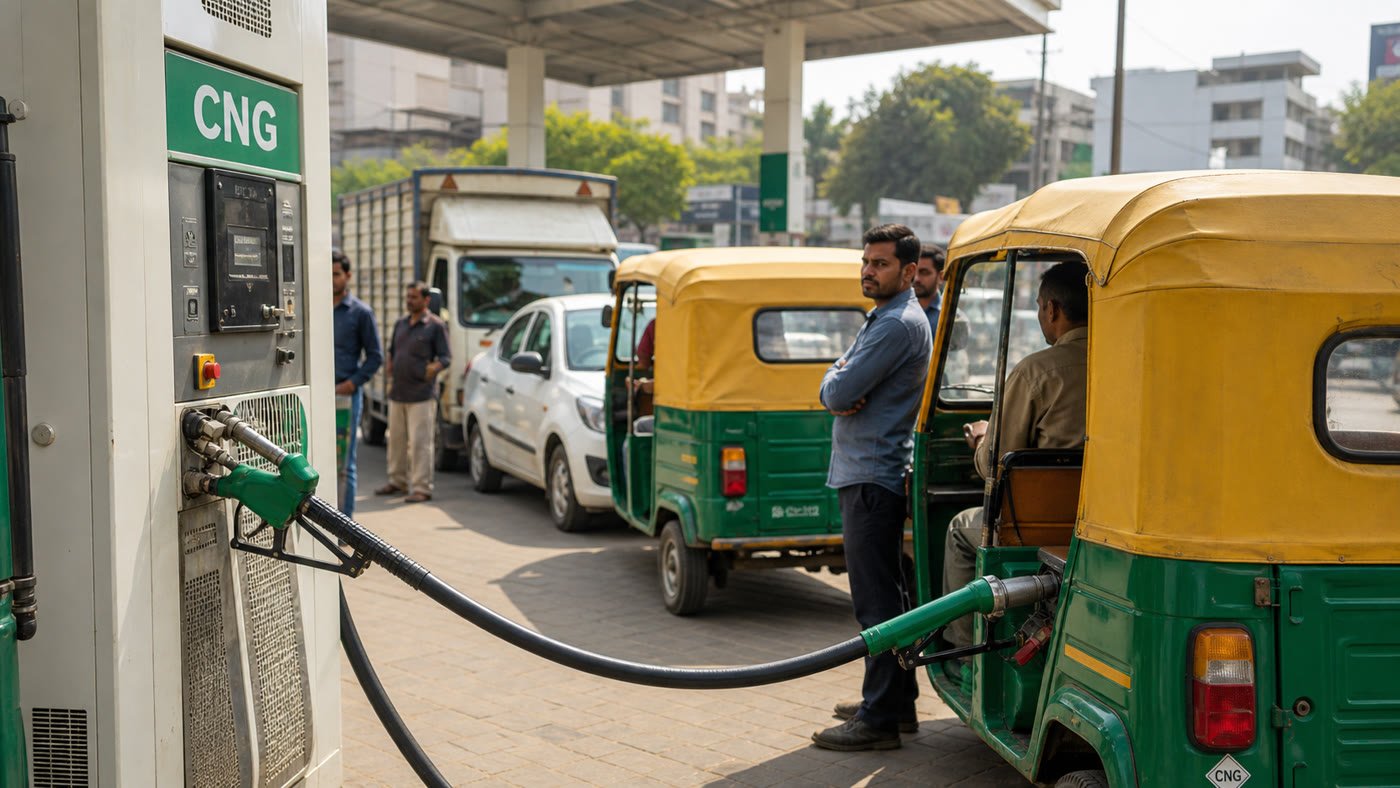
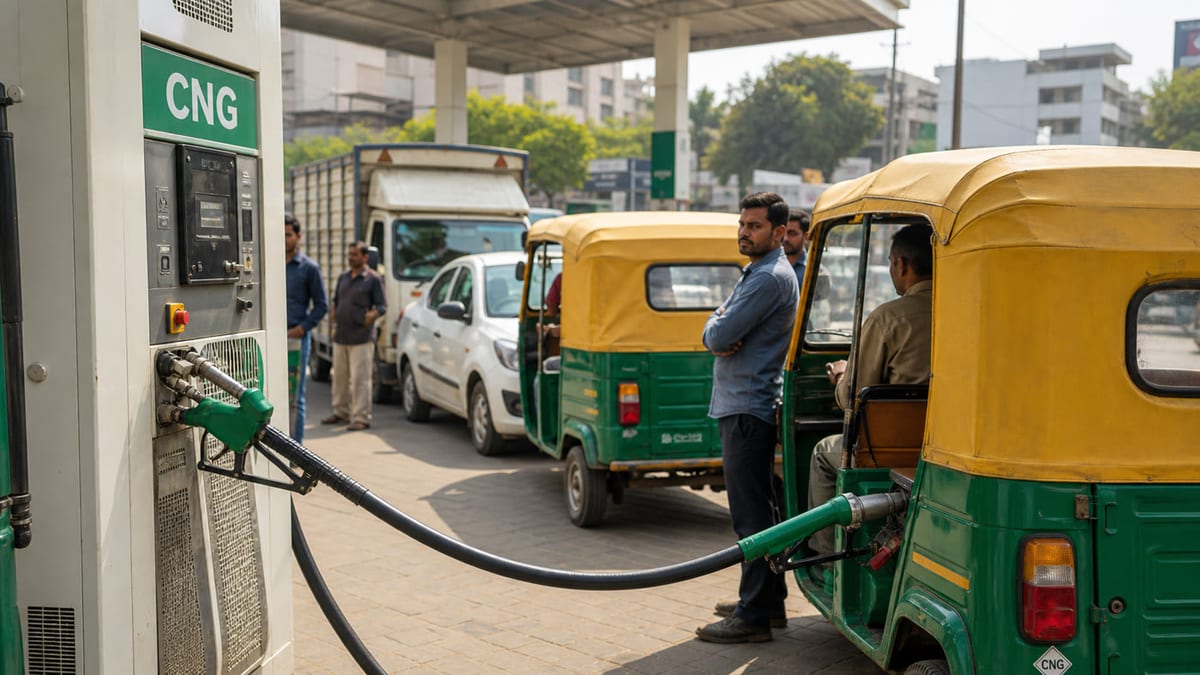
CNG users in Delhi-NCR are facing a sharper fuel-cost reset after Indraprastha Gas Ltd-linked prices moved up for the fourth time in 11 days during May. New Delhi CNG is listed at Rs 83.09 per kg on 5 June 2026 by the Times of India fuel-price tracker, after IGL raised the Delhi rate by Rs 2 per kg with effect from 6 am on May 26. Autocar India reported that the Delhi price had increased by a total of Rs 6 per kg since May 15, with earlier revisions of Rs 2 on May 15, Re 1 on May 17 and Re 1 on May 23.
This is not just another fuel-board change. CNG is the working fuel for thousands of auto-rickshaws, taxis, school vans, small goods carriers and private cars bought specifically for lower running costs. A rapid Rs 6 per kg increase narrows the savings that made CNG attractive in the first place and forces transport users to rework daily earnings, trip fares, delivery charges and monthly household fuel budgets.
Sponsored
What changed in the latest CNG revision
Business Standard reported that city-gas distribution companies raised CNG prices by Rs 2 per kg across Delhi-NCR and Mumbai on May 26 amid elevated energy prices linked to the West Asia conflict. For Delhi, the rate moved to Rs 83.09 per kg from Rs 81.09 per kg. The same report listed Rs 91.70 per kg for Noida and Ghaziabad, Rs 88.12 per kg for Gurugram and Rs 92.44 per kg for Ajmer. Autocar India also listed Delhi at Rs 83.09 per kg and highlighted that IGL pump prices had moved across parts of Haryana, Uttar Pradesh and Rajasthan.
Moneycontrol reported that IGL informed customers about the revised Delhi rates and that the stock rose nearly 4 per cent in early trade on May 26 after the price hike. That market reaction is important. For consumers, the hike is a cost squeeze. For city-gas distributors, higher pump prices can help pass through input-cost pressure and protect margins, provided demand does not slow sharply.
| Area or metric | Reported figure | Why it matters |
|---|---|---|
| New Delhi | Rs 83.09 per kg on 5 June 2026 | Confirms the higher May rate was still visible in early June. |
| Latest Delhi revision | Rs 2 per kg from May 26 | Immediate hit to daily refuelling costs for commercial drivers. |
| Cumulative May increase | Rs 6 per kg since May 15 | Reduces the running-cost advantage of CNG cars and fleet vehicles. |
| IGL stock reaction | Up nearly 4 per cent in early trade on May 26 | Shows investors saw price pass-through as margin support. |
Who feels the pressure first
The first group is auto-rickshaw and taxi drivers. Many drivers use CNG because every rupee saved per kilometre protects daily take-home income. When CNG rises quickly, the driver has only a few choices: absorb the extra cost, drive longer hours, ask for higher fares, reduce non-essential trips or shift more aggressively to app-based dynamic pricing where possible. None of those options is painless.
The second group is last-mile logistics. Small delivery vans, courier vehicles, kirana-supply runs and urban goods carriers often run predictable city routes where CNG has been useful. A Rs 6 per kg increase does not immediately break the model, but it changes cost sheets for operators who have fixed contracts with retailers, e-commerce sellers or local distributors. If the contract does not include a fuel-adjustment clause, the operator carries the hit until the next rate negotiation.
The third group is private CNG car buyers. Delhi-NCR buyers often compare petrol, diesel, CNG and EV options based on expected monthly kilometres. A higher CNG price means the payback period for a factory-fitted CNG model can stretch, especially for low-mileage users. High-mileage drivers can still find CNG useful, but the decision now depends more heavily on real-world fuel economy, local pump access, queue time and the price gap versus petrol and diesel.
Why CNG is rising even though it is a domestic mobility fuel
CNG is sold locally, but its cost chain is not fully local. City-gas distributors source gas through a mix of allocated domestic gas and market-linked supplies. When global energy prices, imported gas costs, freight routes or currency movements turn unfavourable, the landed cost can rise. Business Standard linked the latest price cycle to elevated energy prices during the West Asia conflict, while Autocar India noted IGL's earlier explanation that the price revision only marginally offset higher input gas cost and a steep appreciation of the US dollar.
That is the larger fuel lesson for users. CNG may be cheaper than petrol in many use cases, but it is not immune to global gas volatility. A driver who bought a CNG vehicle for predictable savings must now track not just petrol and diesel prices, but also gas allocation, dollar movement and city-gas distributor pricing behavior.
Impact on inflation and urban mobility
The inflation impact will not be as broad as a nationwide petrol or diesel hike, but it is concentrated where CNG vehicles are common. Delhi-NCR has a large base of CNG three-wheelers, taxis and small commercial vehicles. If drivers pass on the cost, short urban trips become more expensive. If they absorb it, driver income weakens. If delivery operators pass it on, local retail and e-commerce logistics become more expensive at the margin.
The pressure also arrives when petrol and diesel users have already seen higher prices. Business Standard reported that petrol and diesel had also seen multiple increases since May 15, with Delhi petrol above Rs 100 per litre and diesel above Rs 95 per litre in that cycle. That matters because CNG users cannot simply point to petrol and diesel as stable alternatives. Across fuels, the late-May price cycle has pushed urban mobility costs higher.
What vehicle buyers and fleet owners should watch next
For private buyers, the key number is not only the pump price. The real metric is running cost per kilometre after considering mileage, CNG kit premium, boot-space compromise, maintenance, insurance and refuelling time. A higher CNG price does not automatically make petrol or EVs better, but it reduces the margin of safety in CNG purchase calculations.
For fleets, the next watchpoint is whether city-gas prices stabilize or continue to rise in steps. Operators should track fuel clauses in contracts, station-wise availability, queue times and route-level consumption. Cab and delivery fleets should also monitor whether fare cards, aggregator incentives or customer delivery fees adjust quickly enough to avoid margin erosion.
The clear takeaway is that CNG remains an important lower-emission urban fuel, but its economics are no longer a set-and-forget advantage. Delhi-NCR users now need to treat CNG as a variable fuel cost, not a permanently cheap substitute. The May price cycle has reset the running-cost math for drivers, fleets and CNG car buyers.