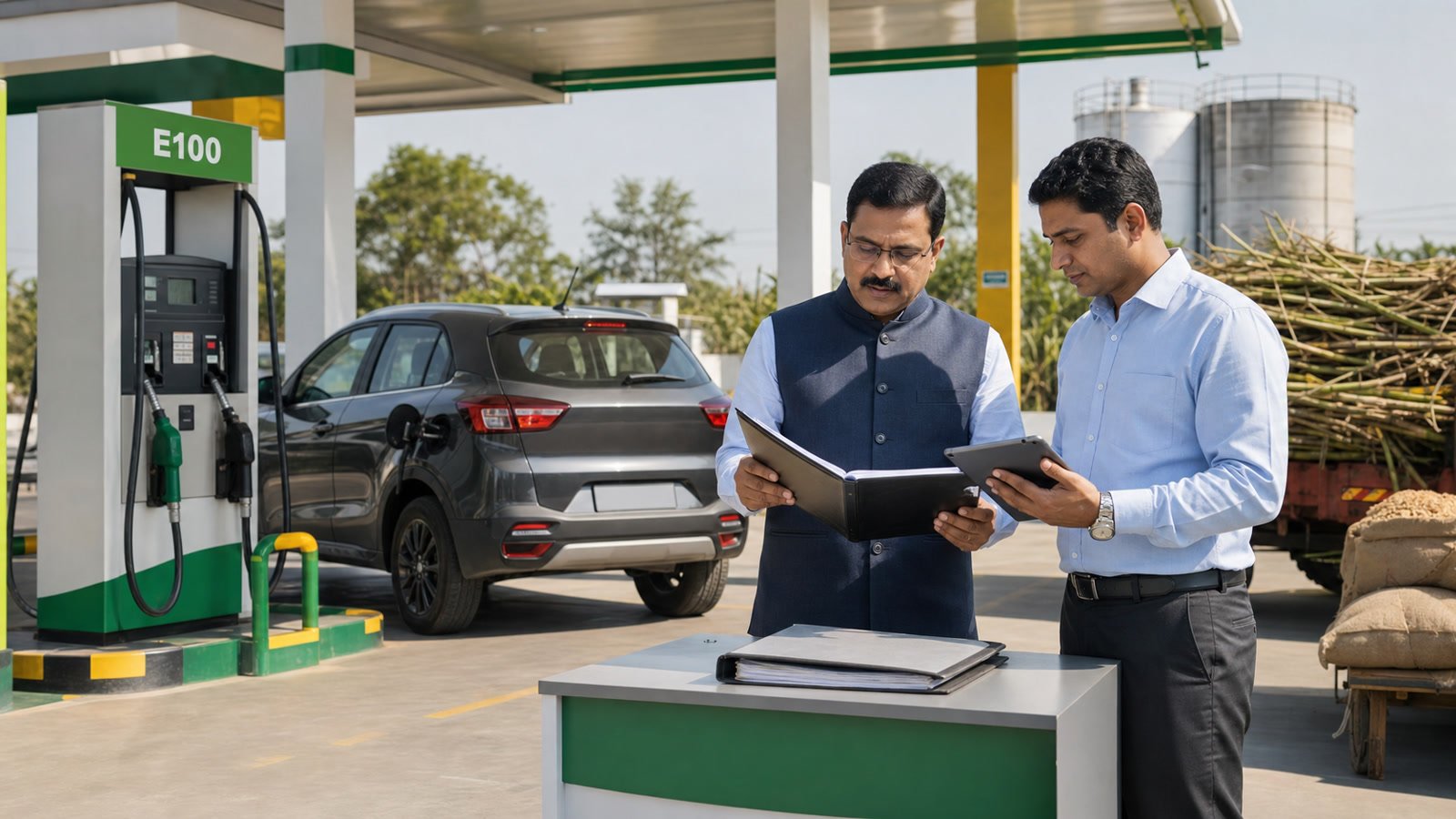
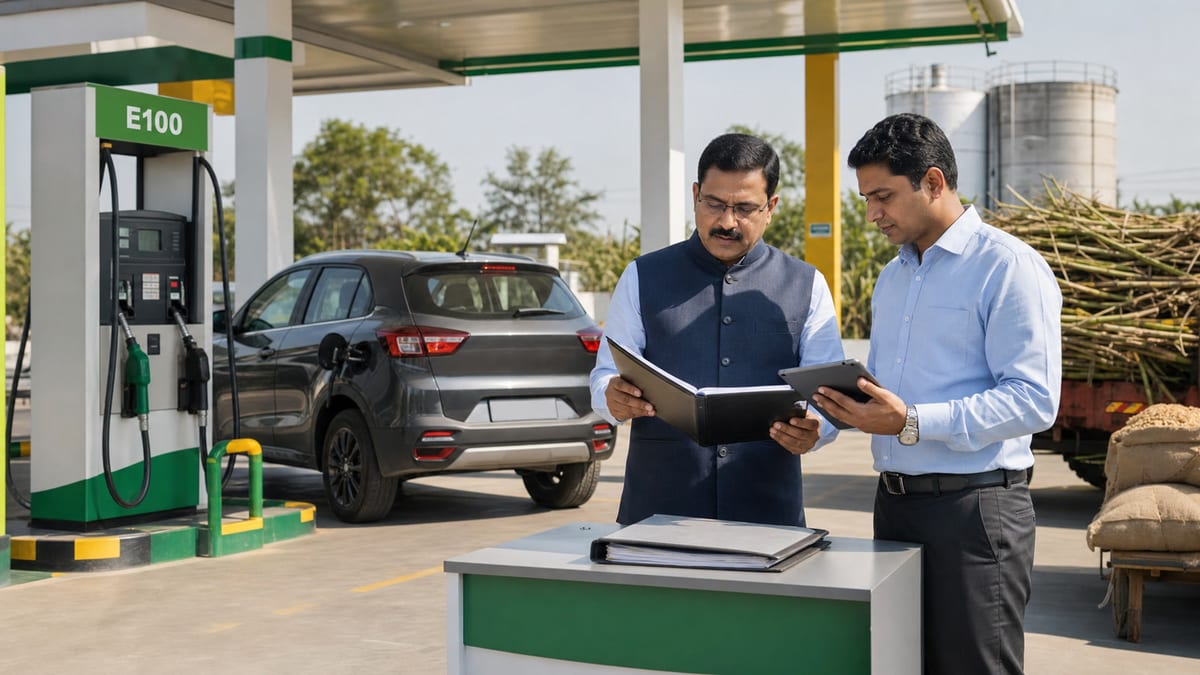
India's ethanol mobility push has moved from blending targets to a clearer vehicle-approval stage. Union Road Transport and Highways Minister Nitin Gadkari has said he has signed the file approving rules for giving legal sanction to 100% ethanol-driven vehicles. Times of India reported on June 14, 2026 that Gadkari said the file was signed at 8 pm on Friday and that he had also launched a 100% ethanol version of a vehicle from a leading automobile company, with other automakers expected to follow.
For FuelPrice readers, this is a high-impact fuel-policy story because E100 is not the same as ordinary petrol blended with ethanol. E20, E22, E25 or E30 still contain a large petrol component. E100 points to a vehicle designed to run fully on ethanol, or a flex-fuel architecture capable of handling very high ethanol content. That means the discussion shifts from whether ethanol can be mixed into petrol to whether India can build, certify, sell, fuel and service vehicles that treat ethanol as the primary fuel.
Sponsored
What changed now
The immediate change is legal and regulatory. Gadkari's statement indicates that rules for 100% ethanol-driven vehicles have moved through an approval file, giving automakers a clearer path to bring E100-compatible products into the market. This matters because vehicle makers cannot scale a new fuel type only on political messaging. They need rules for certification, emissions, safety, fuel-system materials, warranties and compliance before dealers can confidently sell such vehicles.
The timing also matters. Only days earlier, the Centre exempted petrol blended beyond E20 from excise duty, including higher ethanol-petrol grades. Times of India reported that the move is meant to make fuel beyond E20 more attractive for consumers and encourage voluntary use. Economic Times separately reported that the Centre extended the excise waiver for blending more than 20% ethanol with petrol. Taken together, the policy direction is clear: India is building a ladder from E20 mass-market fuel to higher blends and now toward E100-ready vehicles.
Before and after: why E100 is different
Before this stage, most petrol users experienced ethanol as a blend inside regular petrol. The practical questions were about E20 compatibility, mileage, insurance concerns and whether higher ethanol grades such as E22-E30 would be priced attractively. After E100 legal sanction, a different set of questions becomes important: which vehicles can use pure ethanol, how many pumps will stock it, what the retail price will be, and how automakers will communicate warranty coverage.
That distinction is critical for buyers. An existing petrol vehicle should not be treated as E100-ready unless the manufacturer clearly says so. Ethanol has different properties from petrol, and high-ethanol or pure-ethanol use requires compatible fuel lines, seals, engine calibration, cold-start strategies and onboard diagnostics. The buyer takeaway is simple: E100 can be a future petrol substitute for the right vehicle, not a do-it-yourself fuel swap for every car or two-wheeler on the road.
| Area | What E100 approval changes | What users must still verify |
|---|---|---|
| Vehicle buyers | A legal route for E100-compatible models can make flex-fuel buying more credible. | OEM approval, warranty terms, real mileage, service support and fuel availability. |
| Fuel pumps | E100 can become a separate product if demand and supply are ready. | Storage, dispenser labelling, quality control and city-wise rollout. |
| Automakers | Rules can support homologation of high-ethanol vehicles. | Pricing, engine calibration, durability testing and dealer training. |
| Farm and ethanol supply chain | Higher ethanol demand can support domestic biofuel feedstock. | Sustainable feedstock, steady supply, logistics and fair pricing. |
The pricing question cannot be ignored
Ethanol can reduce crude-oil dependence, but buyers will judge it on cost per kilometre. Ethanol generally has lower energy content than petrol, so a cheaper per-litre price may still need to be meaningfully lower to produce real savings. That is why the recent E85 pricing signal matters. Economic Times reported that Oil Minister Hardeep Singh Puri said state-run oil companies would sell E85, a blend of 85% ethanol and 15% petrol, at a Rs 20 per litre discount to offset lower energy content and drive adoption.
E100 will face an even sharper version of that equation. If the fuel is priced attractively and the vehicle is designed for it, users may see lower import-linked exposure and a domestic-fuel advantage. If E100 is priced too close to petrol, or if mileage drops without a clear retail discount, the buyer case weakens. This is why the policy approval is only the first step. Pump pricing, city availability and real-world efficiency will decide whether E100 becomes a niche demonstration fuel or a practical alternative.
Why automakers may respond now
Automakers have waited for regulatory clarity because flex-fuel products need more than a badge change. They require engineering validation, supplier readiness, emission compliance and a dealer network capable of explaining fuel compatibility. A signed approval file gives companies a stronger basis to plan launches, especially if oil companies and fuel retailers can show where high-ethanol fuel will be available.
The market will likely start with limited models, pilot cities or controlled use cases rather than a sudden nationwide shift. That would be sensible. Early buyers need visible pumps, clear fuel labels and transparent warranty language. Fleet operators need route-level availability. Private users need to know whether the vehicle can run on petrol, ethanol blends and E100, or only selected grades. The more precise the communication, the lower the risk of misfuelling and disappointment.
What this means for petrol users today
For most motorists, nothing changes at the pump today. Regular petrol and E20 remain the practical fuel reality in most cities. The Ministry of Petroleum and Natural Gas has already clarified concerns around E20, with Economic Times reporting the government's position that E20 does not void insurance and has minimal mileage impact when used in compatible vehicles. But E100 is a separate stage and needs separate vehicle approval.
That means petrol users should track the transition without assuming immediate savings. If an E100-compatible car or two-wheeler is launched, compare its on-road price, fuel availability, running cost, resale confidence and service support against petrol, hybrid, CNG and EV options. For fleets, the calculation should include fuel contracts, downtime, route coverage and whether high-ethanol fuel can be reliably supplied near depots.
What to watch next
The next important signals are the formal rule text, the first named E100-compatible models, fuel-station rollout plans, retail pricing and warranty language from automakers. Also watch whether the government links E100 with sustainable aviation fuel and farm-biomass supply, because Gadkari also referred to biomass-based sustainable ATF and a Rs 10,000 crore package aimed at stabilising ATF prices at Rs 115 per litre. That wider biofuel agenda shows that the E100 approval is part of a larger strategy to reduce petroleum dependence across road and air transport.
The reader takeaway is clear. Legal sanction for 100% ethanol-driven vehicles is a meaningful milestone, but it is not an overnight petrol replacement for all users. It gives automakers permission to move faster, gives fuel retailers a reason to plan high-ethanol supply, and gives buyers a new option to evaluate. The real test will be whether E100 vehicles are priced sensibly, supported by fuel availability, protected by clear warranties and cheaper enough per kilometre to matter in everyday use.
Sources: Times of India E100 vehicle approval report, Times of India higher-ethanol excise report, Economic Times E20-plus excise report, Economic Times E85 pricing context, Economic Times E20 compatibility clarification.