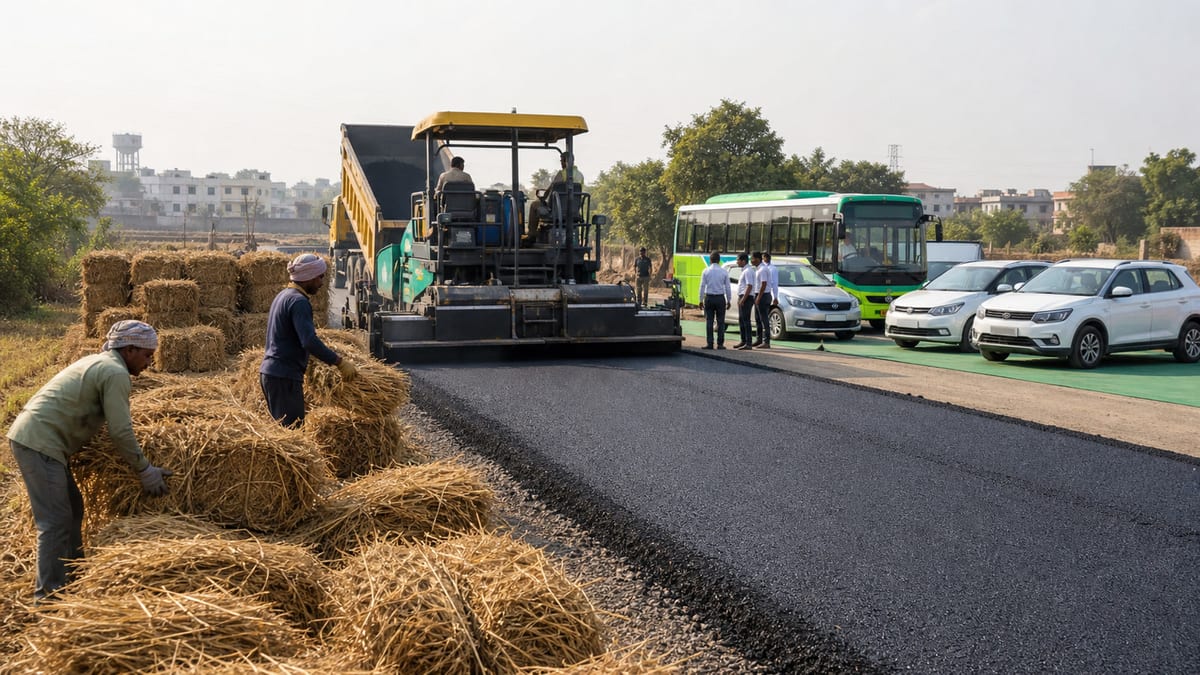
Union Road Transport and Highways Minister Nitin Gadkari has again pushed the fuel transition into practical territory. Times of India reported on June 13, 2026 that Gadkari, speaking in Nagpur, urged public representatives and civic officials to move toward vehicles powered by biofuels and other sustainable energy sources instead of continuing with petrol and diesel. He also highlighted rice straw, or parali, as a raw material for bitumen used in road construction, and said work was under way to produce aviation fuel from the same agricultural residue.
For FuelPrice readers, this is not just a green slogan. It connects three parts of the fuel economy that usually get discussed separately: what vehicles run on, what roads are built with, and how agricultural waste can reduce dependence on imported petroleum products. Petrol and diesel still dominate Indian mobility, and petroleum-based bitumen remains central to road construction. If biofuels and bio-bitumen move from pilots to regular use, the impact can reach motorists, municipal fleets, contractors, farmers, oil import bills and future vehicle choices.
Sponsored
What Gadkari said now
The latest TOI report says Gadkari advised Nagpur's mayor and other leaders to adopt vehicles running on biofuels and sustainable energy. He linked this to the government's Waste to Wealth work, saying agricultural waste is producing results in the form of natural gas and fuels. The report also said discussions are in progress to blend a portion of these alternative fuels into existing fuel supplies.
The timing matters. Fuel users are already watching crude-oil volatility, West Asia supply risk, ethanol blending, bulk-fuel rules and transport costs. Gadkari's message is that public officials and civic bodies should not wait for a distant future before changing fleet choices. Municipal cars, buses, utility vehicles, waste-collection vehicles and contractor fleets can become early adopters because their routes are predictable and their procurement can be planned.
Before and after: why rice straw matters
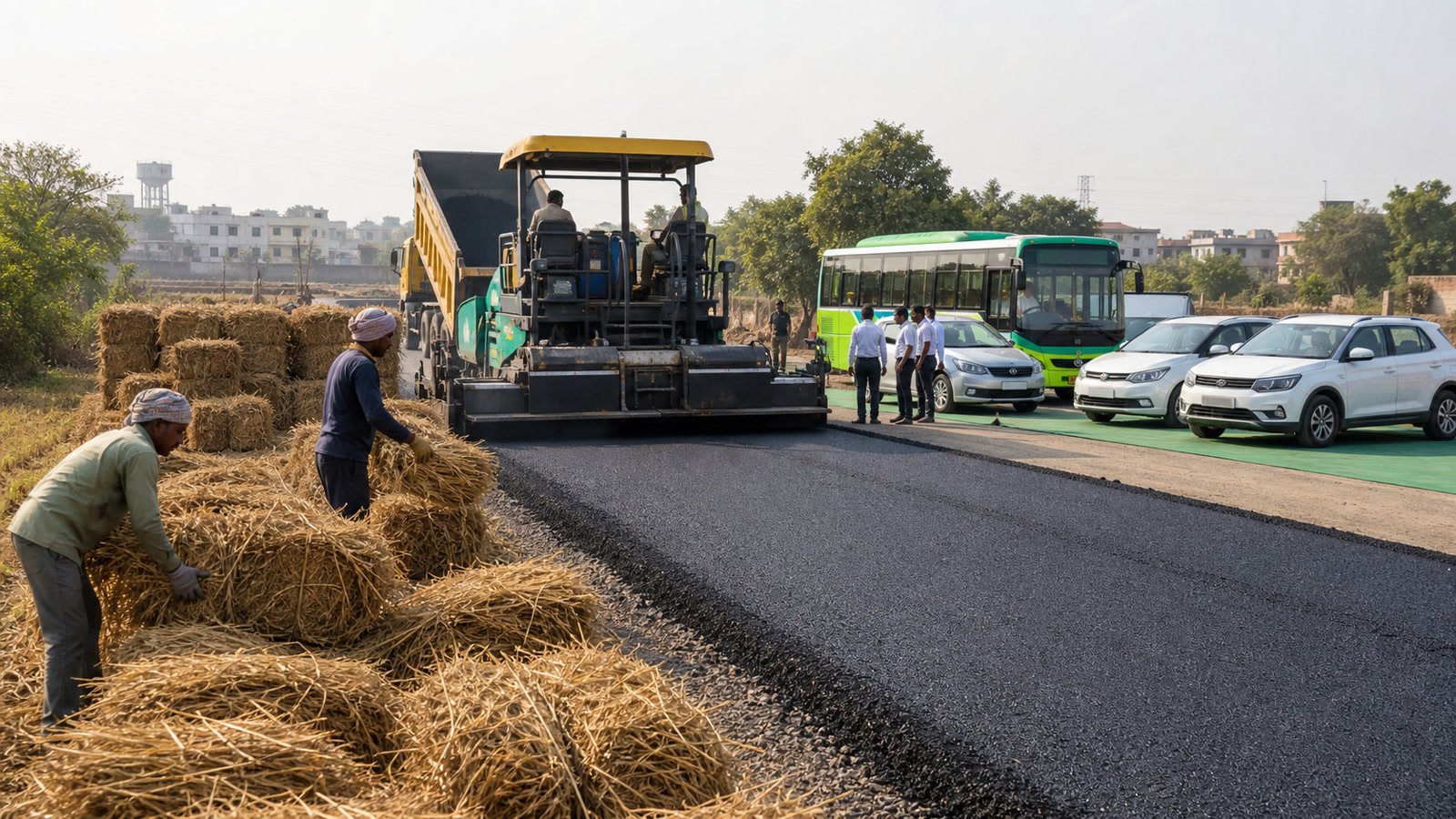
The old model treats crop residue as a disposal problem and petroleum bitumen as a road-construction input. The new model tries to convert part of that farm waste into useful road material. TOI reported earlier this year that CSIR's Central Road Research Institute and Indian Institute of Petroleum developed an indigenous process to produce bio-bitumen from agricultural residue, mainly rice straw, through pyrolysis. The crop residue is converted into bio-oil and then processed into a bio-binder suitable for bituminous roads.
That change matters because rice-straw burning has been a recurring pollution problem in north India, while India also imports petroleum products and bitumen-related inputs. If a reliable share of bitumen can be replaced by a domestic bio-binder, the same tonne of residue can serve a cleaner economic purpose instead of becoming smoke. It also gives farmers and collection networks a possible value chain beyond food production.
| Area | Current dependence | What the biofuel push changes |
|---|---|---|
| Passenger and civic vehicles | Petrol and diesel remain the default for many official and urban fleets. | Biofuel, CBG, ethanol, electric and hybrid choices can be tested first on predictable duty cycles. |
| Road construction | Conventional petroleum bitumen is widely used in asphalt roads. | Bio-bitumen can partially replace petroleum-based material where standards and supply are ready. |
| Farm residue | Rice straw is often a low-value disposal challenge after harvest. | Collection for bio-bitumen, ethanol, gas or SAF can create a rural energy value chain. |
| Fuel users | Pump-price exposure is tied to petrol, diesel and crude-import volatility. | More domestic substitutes can reduce some exposure, but vehicle compatibility and availability remain critical. |
The numbers behind the idea
The bio-bitumen claim is not only conceptual. TOI's February report, citing Union Minister of State for Science and Technology Jitendra Singh's Lok Sabha reply, said the indigenous bio-bitumen technology could replace up to 30 percent of conventional bitumen in suitable applications. It also said that even a conservative 15 percent blending level across road projects could save around Rs 4,000 crore a year in foreign exchange by reducing petro-bitumen imports. A separate TOI report from January said the technology was transferred to 14 companies for commercial manufacturing and scale-up, and described earlier road trials in Meghalaya as having maintained highway quality through two monsoons.
Those details are important because they move the conversation from aspiration to deployment. A pilot road is not the same as nationwide adoption, but industry transfer, field trials and blending estimates suggest the technology is being prepared for scale. The next tests will be cost, quality consistency, BIS and IRC acceptance, feedstock logistics, contractor confidence and whether state road agencies actually include bio-bitumen in tenders.
Why this matters for petrol and diesel users
Bio-bitumen will not directly lower tomorrow's petrol price. That would be the wrong expectation. Its relevance is broader: India spends heavily on petroleum imports, and transport fuel prices are sensitive to global oil, rupee movement and supply risk. Every credible domestic substitute, whether it is ethanol in petrol, biogas for fleets, electric buses, hydrogen pilots or bio-bitumen for roads, chips away at one part of that dependence.
For motorists, the more immediate impact comes through vehicle and fuel choices. Ethanol blending has already moved into the mainstream fuel conversation. TOI reported on June 12 that petrol blended beyond E20, including E22 and higher grades, has been exempted from excise duty to encourage voluntary adoption of higher ethanol blends. That policy context supports Gadkari's message, but it also raises practical questions for users: Is the vehicle compatible? Is the blend available nearby? What happens to mileage? Does the warranty allow it? Are service centres trained for flex-fuel systems?
For civic bodies, the first question is different. They can specify vehicle procurement, choose fuel contracts, and create demand for alternative fuels at depots. If city fleets move to CBG, ethanol-compatible vehicles, electric buses or other cleaner fuels where suitable, they create a visible market that fuel suppliers can serve. Public representatives using such vehicles can also normalise the transition, but only if the fuel is available and the economics work without hidden downtime.
What needs to happen next
The strongest version of this transition needs discipline, not only announcements. For bio-bitumen, the key requirement is a reliable supply chain from farms to processing units to road projects. Rice straw must be collected, stored, transported and processed at predictable cost. Road agencies need standards, contractors need confidence, and quality testing must be transparent. If the product performs well but supply is irregular, adoption will remain limited.
For biofuel vehicles, the priority is compatibility and infrastructure. A fleet cannot shift away from petrol or diesel unless the fuel is available on its route or at its depot. Consumers should not assume every existing petrol vehicle is ready for every ethanol blend. Fleet managers should verify manufacturer approval, fuel contracts, maintenance rules and total cost of ownership before making procurement decisions.
Reader takeaway
Gadkari's latest biofuel push is important because it links road infrastructure, agricultural residue and vehicle fuel choices into one practical fuel-security discussion. Rice-straw bitumen can reduce some dependence on petroleum-based road materials, while biofuels and cleaner fleet choices can reduce reliance on petrol and diesel in specific use cases. The change will not happen overnight, and it will not remove the need for petrol or diesel immediately. But it gives India a more local, circular and fuel-diversified pathway at a time when imported energy remains expensive and uncertain. Fuel users should watch not only pump prices, but also standards, tenders, fleet procurement and fuel availability. That is where the shift from promise to real savings will be decided.
Sources: Times of India June 13 Gadkari biofuel report, Times of India bio-bitumen and CSIR context, Times of India farm-residue-to-road technology transfer background, Economic Times crop-waste-to-roads background, Times of India ethanol excise context.