Honda Activa-e and QC1 Hit Best Monthly EV Scooter Retail Sales in May: Fuel Shift Signal Explained
Honda Motorcycle & Scooter India has recorded its highest monthly retail sales for the Activa-e and QC1 electric scooters in May 2026. According to Autocar Professional's Vahan-based sales analysis, Honda delivered 520 units of the two electric scooters last month, crossing the 500-unit monthly mark for the first time. The number is still modest in India's fast-growing electric two-wheeler market, but the signal matters because Honda is the country's strongest petrol-scooter name trying to build credibility in EV scooters.
The May number represents a 36 percent year-on-year increase from 383 units in May 2025 and beats Honda's previous monthly high of 461 units recorded in July 2025. Cumulative retail sales of the Activa-e and QC1 stood at 5,439 units by the end of May 2026. Autocar Professional also reports SIAM data showing total wholesales of 6,505 units till the end of April 2026 and production of over 11,000 units.
Sponsored
Why this matters beyond one monthly number
Honda is not yet a large EV scooter player in India. TVS Motor and Bajaj Auto are each operating at a much higher electric scooter scale, with monthly volumes in the tens of thousands. That makes Honda's 520-unit month small in absolute terms. The more important point is direction: a legacy ICE scooter leader is beginning to show a visible retail response after a slow start.
For FuelPrice readers, the fuel angle is direct. The traditional Activa name is deeply linked to petrol scooter usage in India. If even a small share of Honda's large petrol-scooter customer base begins shifting to electric alternatives, the effect will be felt in city-level fuel demand, household running-cost calculations and dealership investment patterns. The transition will not be instant, but retail momentum from a trusted legacy brand can influence cautious buyers who have waited for familiar names before considering an EV.
Two scooter formats, two buyer groups
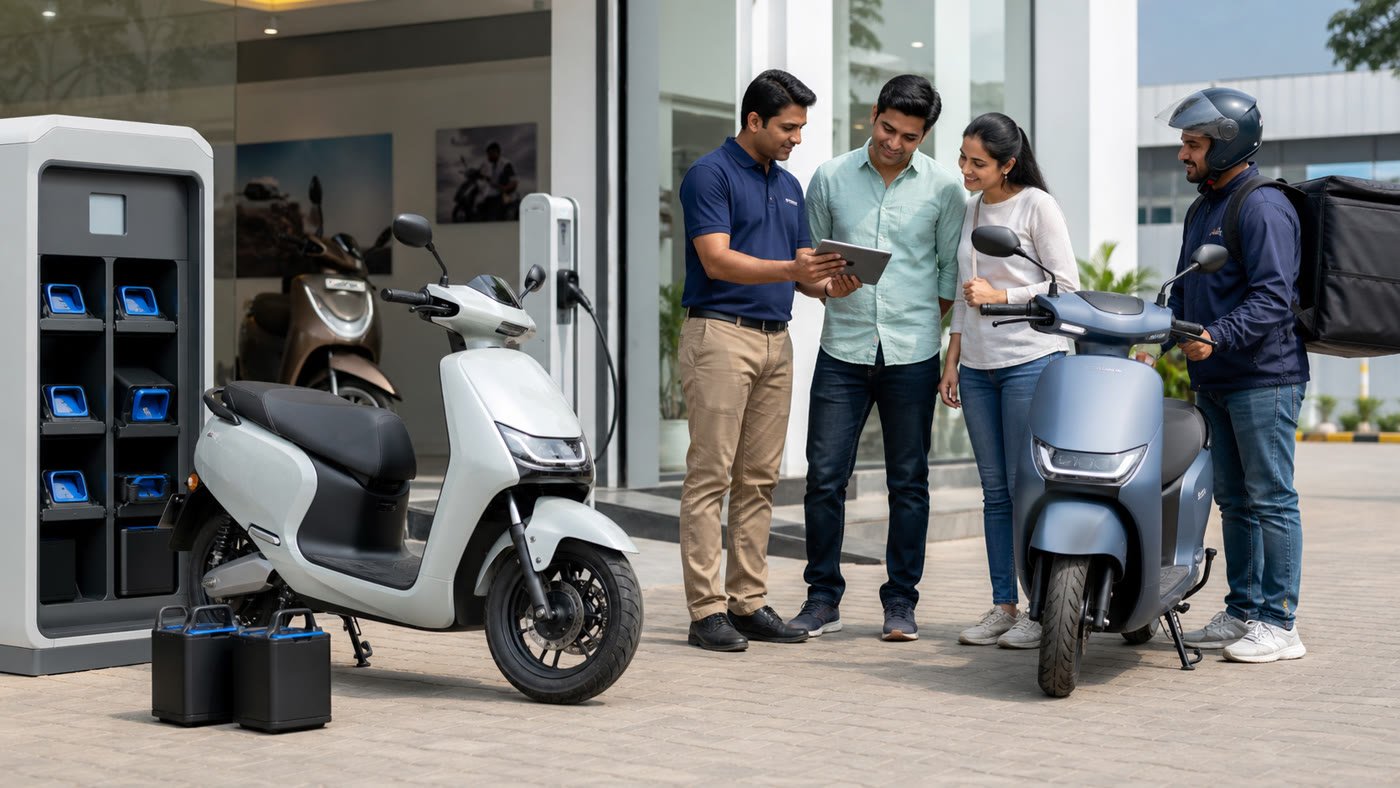
The Activa-e and QC1 are not the same proposition. The Activa-e uses Honda Mobile Power Pack swappable batteries and is positioned as a personal electric commuter with a claimed IDC range of 102 km and a top speed of 80 km/h. Autocar Professional lists prices at Rs 119,912 for the standard version and Rs 152,000 for the RoadSync Duo variant.
The QC1 is simpler and more affordable. It uses a fixed battery, has a claimed IDC range of 80 km, a reported top speed of 50 km/h and is priced around Rs 90,487 ex-showroom in Autocar Professional's report. Honda's global announcement had positioned QC1 as an India-focused, fixed-battery commuter for short-distance use. That makes it more relevant to students, city commuters, gig workers and users who value low purchase cost over high speed or long range.
| Model | Battery approach | Key reported figures | Likely buyer use case |
|---|---|---|---|
| Activa-e | Two swappable batteries | 102 km IDC range, 80 km/h top speed | Family commuter, daily petrol-scooter replacement |
| QC1 | Fixed battery | 80 km IDC range, 50 km/h top speed | Urban runabout, short commutes, gig-work use |
Honda versus other Japanese EV entrants
Honda's May retail performance also matters because Japanese two-wheeler brands are now moving beyond observation into actual EV sales. Autocar Professional reports that between January and May 2026, Honda retailed 1,574 electric scooters, narrowly ahead of Suzuki's 1,515 units for the e-Access during the same period. Yamaha's EC-06 stood at 274 units till the end of May 2026.
This comparison is important for buyers and dealers. Electric scooter adoption in India has so far been led by companies that moved early and built EV-specific products, service systems and charging expectations. Legacy brands bring trust, dealership reach and petrol-scooter customer relationships, but they must still prove EV performance, battery support, after-sales service and resale confidence. Honda's 500-plus month suggests interest is improving, but the company still needs scale.
What changes for fuel users
A petrol scooter owner evaluating an EV usually asks practical questions first: daily kilometres, charging or swapping access, real-world range, battery warranty, service support, purchase price, resale value and monsoon reliability. The Activa-e addresses range anxiety through battery swapping where the swap network exists. The QC1 takes the lower-cost fixed-battery route for shorter city trips. Both are attempts to reduce the friction that stops petrol-scooter users from switching.
The running-cost advantage of electric scooters can be meaningful for users riding 25-60 km a day, especially delivery riders and office commuters. But the market will not shift only because electricity is cheaper than petrol. Buyers need convenient energy access. If swap points are too few or home charging is difficult, the theoretical saving becomes less persuasive. That is why Honda's sales growth must be read together with network expansion, not just model availability.
What to watch next
The next indicators are city-level availability, battery-swap footprint, monthly retail consistency, service response, and whether Honda can move from a 500-unit month toward multi-thousand monthly sales. Also watch Suzuki's e-Access and Yamaha's EC-06 because Japanese legacy brands are now competing for the same cautious EV buyer pool.
The reader takeaway is simple: Honda is still small in India's EV scooter race, but May 2026 shows its electric scooter story is no longer invisible. If the Activa-e and QC1 continue gaining retail traction, Honda could become a serious bridge for petrol-scooter households and gig riders considering their first electric two-wheeler.