India has taken a niche but important step for the next phase of vehicle safety technology. According to a June 13, 2026 Economic Times report, the government has removed traditional licensing requirements for devices operating in the 5.9 GHz and 77-81 GHz radio frequency bands. These are not consumer-facing buzzwords, but they matter because 5.9 GHz is closely associated with vehicle-to-everything communication, while the 77-81 GHz band is widely used for automotive radar applications.
For a vehicle buyer, fleet operator or transporter, the change will not immediately appear as a lower fuel bill or a new dashboard feature tomorrow morning. Its importance is upstream. By reducing spectrum licensing friction, India can make it easier for automakers, component suppliers, testing agencies and mobility technology companies to build, import, test and deploy devices that support collision warnings, adaptive cruise assistance, blind-spot monitoring, emergency braking support, intersection alerts and connected-vehicle traffic information.
Sponsored
That is why this is a FuelPrice story even though it is not a petrol or diesel price revision. Road crashes, sudden braking, congestion, highway stoppages and fleet downtime all carry fuel and logistics costs. A truck stuck after a secondary collision burns diesel while idling. A cab fleet loses productive kilometres when vehicles are damaged. A private car owner pays through repair bills, insurance claims and lost time. Better safety technology does not remove those costs by itself, but it can reduce the probability and severity of events that create them.
What has changed
The reported change exempts devices in the 5.9 GHz and 77-81 GHz bands from the old licensing burden. In practical terms, that means a manufacturer or technology provider should face fewer approval hurdles linked specifically to spectrum licensing when working with eligible vehicle safety devices. It does not mean every device can be sold without compliance checks. Product certification, type approval, testing, cybersecurity, electromagnetic compatibility, privacy requirements and vehicle-level validation still remain critical.
The difference is that spectrum access is a foundational layer. If the spectrum treatment is unclear or restrictive, companies hesitate to invest in hardware, roadside infrastructure and software ecosystems. When the rules are clearer and lighter, suppliers can plan India-specific modules, automakers can localise safety features, and fleet technology providers can run pilots with more confidence.
Why 5.9 GHz and 77-81 GHz matter
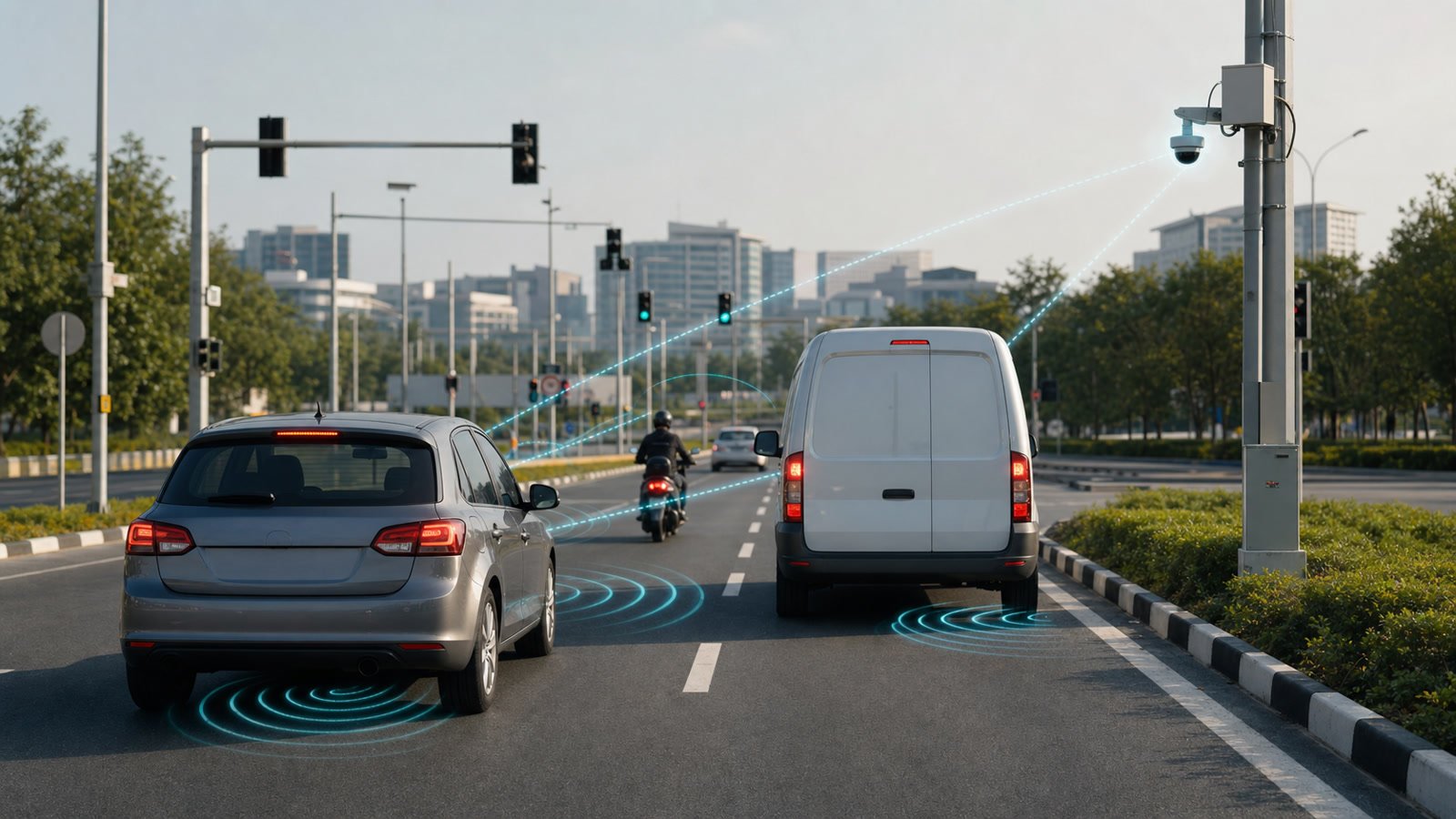
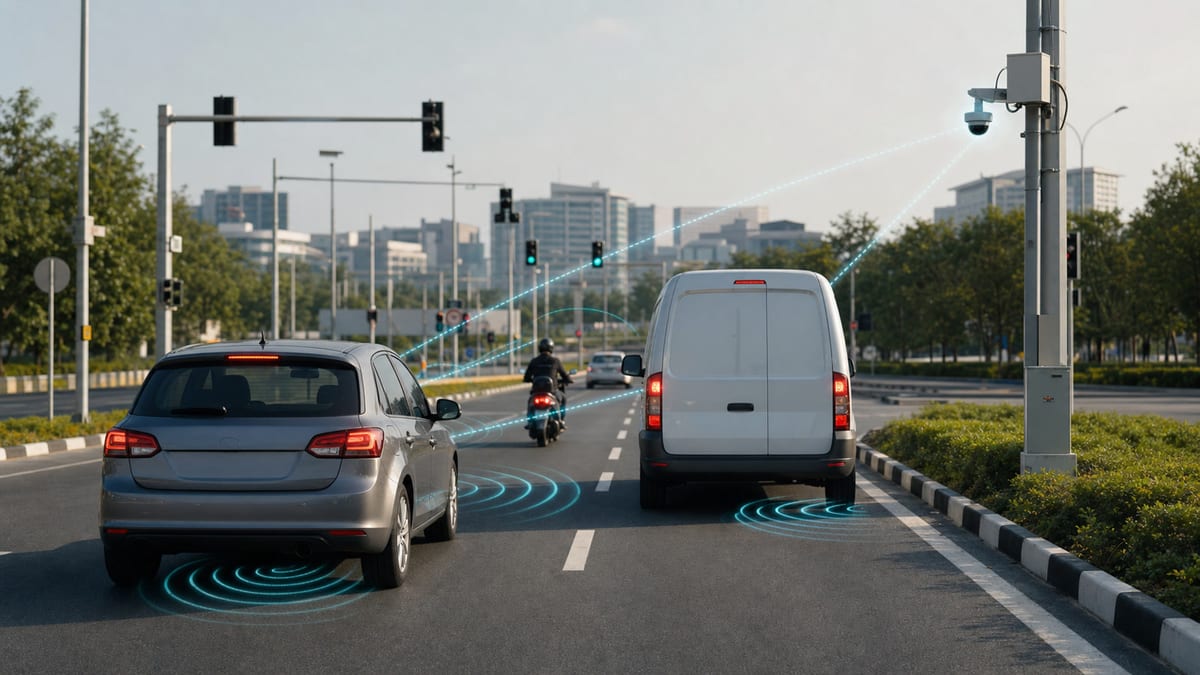
The 5.9 GHz band is important for connected mobility because it can support short-range communication between vehicles, traffic infrastructure and other road users. In a mature V2X environment, a car could receive a warning that another vehicle has braked hard beyond the driver's line of sight. A bus could communicate with a traffic signal. A highway work zone could alert approaching vehicles. A two-wheeler or vulnerable road user could become more visible to nearby connected vehicles if the surrounding ecosystem supports it.
The 77-81 GHz band is important for automotive radar. Radar sensors help a vehicle detect range, speed and movement around it even when visibility is imperfect. Depending on the vehicle and software, radar can support forward collision warning, adaptive cruise control, automatic emergency braking, rear cross-traffic alert and blind-spot detection. In premium cars, many of these features are already familiar. The bigger Indian-market question is how quickly reliable safety-assist features can move from expensive trims to mainstream cars, commercial vehicles and fleet applications.
| Technology layer | What it can support | Why FuelPrice readers should care |
|---|---|---|
| 5.9 GHz V2X | Vehicle-to-vehicle, vehicle-to-infrastructure and road-event warnings. | Can reduce surprise braking, traffic shockwaves and accident-related delays when deployed at scale. |
| 77-81 GHz radar | Distance and speed sensing for ADAS functions such as collision warning and adaptive cruise. | Can reduce crash risk, vehicle downtime and repair-linked operating cost for private and fleet users. |
| Roadside units and smart corridors | Signal alerts, hazard messages, queue warnings and possible future toll or traffic coordination. | Better traffic flow can cut idling, wasted fuel and unpredictable freight delays. |
The road-safety context
India's road-safety challenge is large, and it cannot be solved by spectrum policy alone. The Ministry of Road Transport and Highways maintains official road accident data, while Bharat NCAP has been building consumer awareness around crash safety, safety-assist technologies and vehicle ratings. This policy move fits into that broader direction: vehicles should not only protect occupants during a crash, they should increasingly help avoid crashes where possible.
Bharat NCAP's public material also shows why the next wave of safety will not be limited to body structure and airbags. Its evaluation scope includes safety-assist technologies, and its guidance explains that consumers should consider day-to-day safety features, not just minimum roadworthiness. V2X and radar sit in that prevention layer. They can help the vehicle understand risk earlier than the driver in some situations, provided the system is well engineered and properly calibrated.
Who is affected first
Automakers and Tier-1 suppliers are the first direct beneficiaries because they can plan hardware and software roadmaps with less regulatory uncertainty around these bands. Testing labs, telecom-linked mobility players and smart-highway technology firms could also benefit as India experiments with intelligent transport systems. The user impact will arrive later, through more models offering radar-based ADAS, connected safety alerts and fleet safety products.
Commercial fleets should watch this closely. A long-haul truck, intercity bus or urban delivery van has a different safety-cost equation from a private car. A single crash can mean repair downtime, cargo delay, insurance escalation, fuel wasted in detours, driver injury risk and reputational damage. If radar and connected-warning systems become more affordable and easier to certify, fleet operators may eventually treat them as cost-control tools, not just premium safety extras.
Two-wheeler users and pedestrians also matter in this discussion. India's traffic mix is not a clean lane-by-lane environment made only of cars. Any serious V2X roadmap will need to consider motorcycles, scooters, pedestrians, autorickshaws, buses, trucks, roadworks and mixed-speed traffic. The technology must be tuned for Indian conditions, not just imported from markets with more disciplined traffic patterns.
What this does not mean
The exemption should not be read as a sudden arrival of autonomous driving on Indian roads. Self-driving capability requires far more than spectrum access. It needs high-quality sensors, robust software validation, road markings, maps, fail-safe design, driver monitoring, liability clarity, cybersecurity, service support and clear rules for mixed traffic. Even ADAS features already sold in India can behave differently depending on weather, road markings, vehicle maintenance and driver misuse.
There is also a buyer-education risk. If dealerships market radar and connected features as a replacement for attention, the safety benefit can be diluted. These systems should be explained as assistance, not permission to disengage. For FuelPrice readers comparing new vehicles, the right question is not only whether a car has ADAS, but which functions are available, how they are tested, how they behave in Indian traffic, and what repair or calibration costs apply after bumper damage or windshield replacement.
What to watch next
- OEM announcements: More India-made models may add radar-based safety features if suppliers can localise modules at scale.
- Fleet pilots: Logistics companies may test collision-warning and driver-assistance systems to reduce downtime and insurance risk.
- Smart corridor projects: Expressways, toll corridors and urban intersections could become early V2X testbeds.
- Standards and compliance: Buyers should watch for clear Indian testing protocols, repair guidance and cybersecurity safeguards.
- Feature pricing: The real market shift will happen when safety tech moves beyond top variants and luxury models.
The takeaway is clear: de-licensing these bands is not a flashy launch, but it is an enabling policy change. If implemented with strong testing and honest consumer communication, it can help India move from passive crash protection toward more active crash prevention. For road users, vehicle buyers and fleet owners, the long-term value is fewer disruptions, lower accident-linked costs and safer mobility, not simply more technology on a brochure.
Sources: Economic Times report on India's 5.9 GHz and 77-81 GHz exemption, Ministry of Road Transport and Highways road accident data page, Bharat NCAP official vehicle safety programme.