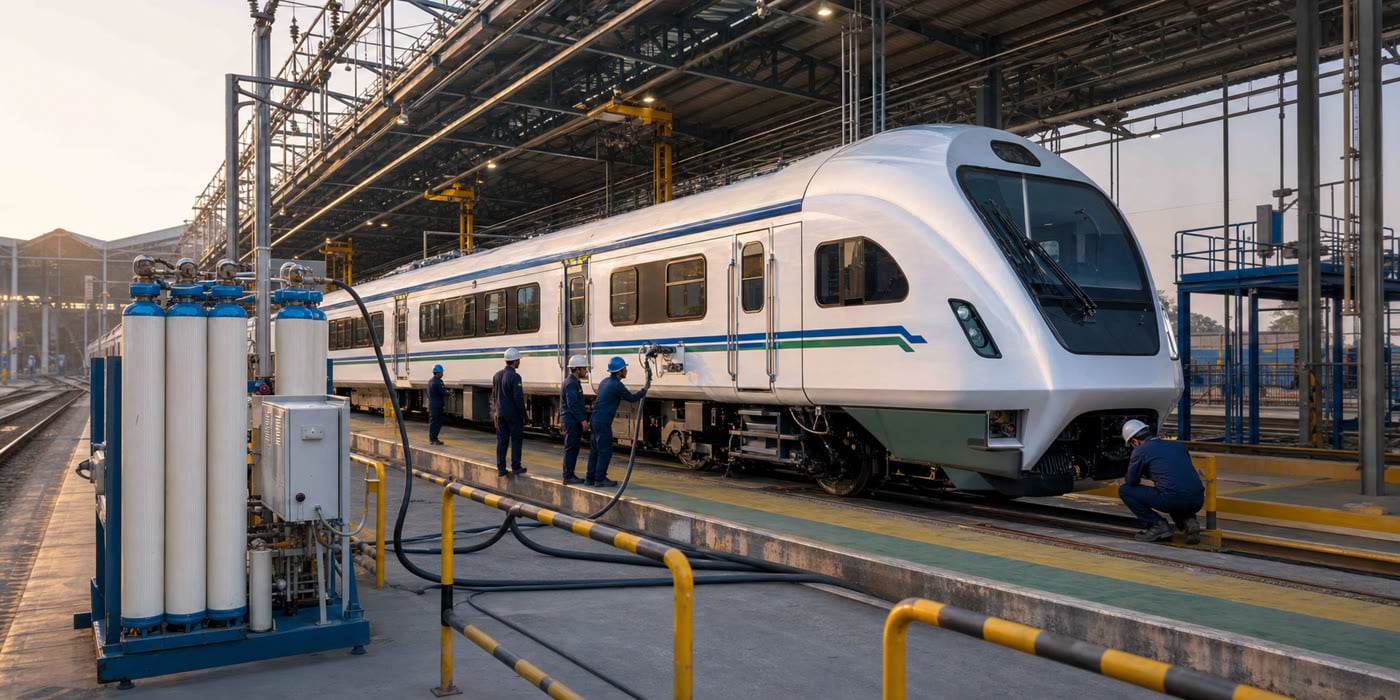
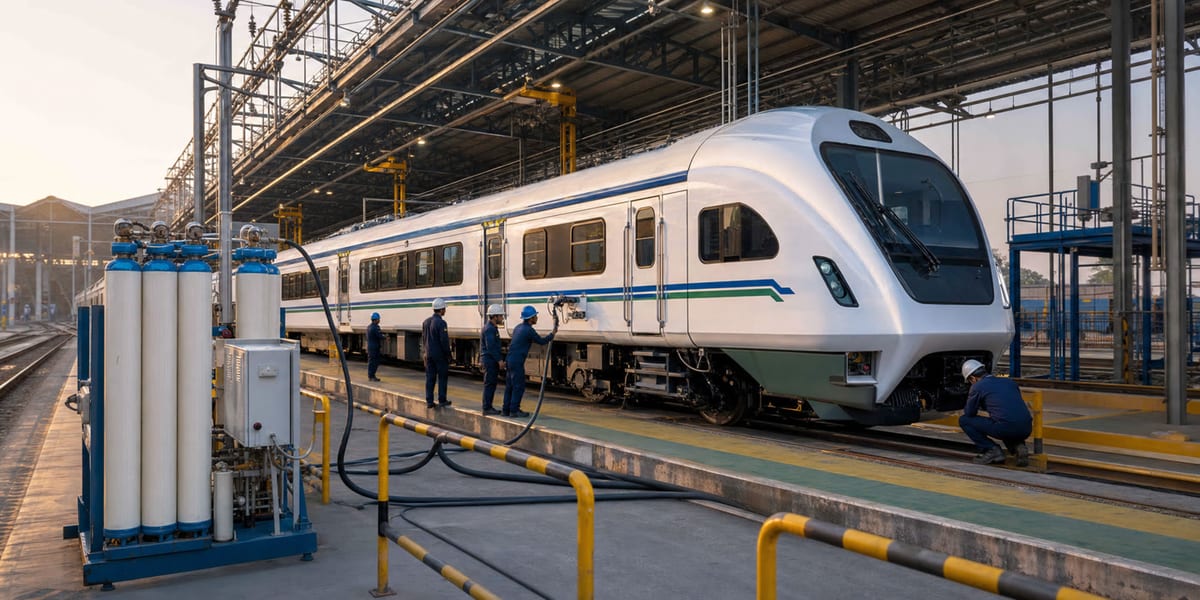
India's hydrogen train project moved from a technology headline to an operations-readiness story this week. On 5 June 2026, Railway Minister Ashwini Vaishnaw reviewed the Hydrogen Train and advanced maintenance facilities at Shakur Basti Depot, according to the Ministry of Railways release issued through PIB. The visit matters because hydrogen trains are not only about a new trainset; they require refuelling safety, trained staff, depot maintenance systems, route planning and reliable operating protocols.
The review follows Indian Railways' approval for a 10-car hydrogen fuel-cell trainset on the Jind-Sonipat section of Northern Railway. The project is one of India's most important clean-fuel mobility pilots because it tests whether hydrogen can replace diesel traction on selected non-electrified or operationally suitable rail sections without local tailpipe emissions. For FuelPrice readers, the relevance is direct: it shows how transport fuel choices are expanding beyond petrol, diesel, CNG and electricity into hydrogen for public mobility.
Sponsored
What happened at Shakur Basti
PIB said the Railway Minister inspected the Tilak Bridge-Shakur Basti rail section of Northern Railway and reviewed development works with senior officials. At Shakur Basti Station, he examined the Retractable Overhead Equipment system, a facility designed to support safer and more efficient maintenance of locomotives and trains inside maintenance sheds. He also inspected bogie pit and bogie lifting facilities and asked officials to improve operational efficiency at ground level.
The hydrogen train was a key highlight of the visit. The ministry described the project as an environmentally friendly green technology initiative and linked it with the long-term goal of making Indian Railways pollution-free. The same release noted Indian Railways' movement toward full electrification and its net-zero carbon commitment, placing hydrogen in a wider clean-transport strategy rather than treating it as a standalone experiment.
The Jind-Sonipat hydrogen train plan
In a separate official release on 27 May 2026, Indian Railways said it had approved the introduction of a 10-car hydrogen fuel-cell trainset on the dedicated Jind-Sonipat section. The trainset is approved for a maximum speed of 75 kmph and is powered by a 1200 KW hydrogen fuel-cell propulsion system. Indian Express, Financial Express and Economic Times also reported the Railway Board approval and the Jind-Sonipat operating plan.
The pilot route matters because hydrogen rail is still a developing technology globally. PIB said India joins a select group of countries, including Germany, Japan, China and the United States, that are exploring hydrogen for cleaner rail transportation. Hydrogen fuel cells generate electricity through a chemical reaction using hydrogen, with water vapour as the local emission. That makes the technology especially relevant for routes where diesel use is being reduced but full electrification may not be the only operating answer.
Why fuel users and transport planners should care
The project will not change petrol or diesel pump prices. Its impact is different: it shows how large public transport systems can reduce dependence on diesel in targeted use cases. Diesel remains central to buses, trucks, tractors and some rail operations. Any proven alternative that can handle passenger duty safely and reliably creates options for future fleet planning.
Hydrogen trains are also a useful test of the whole fuel ecosystem. A train cannot run on a press release. It needs hydrogen production, compression, storage, dispensing, safety sensors, maintenance manuals, operating procedures and certified staff. That is why the Shakur Basti review is important. A depot that can safely maintain and inspect the trainset is as critical as the fuel-cell stack on the train.
Safety and refuelling are central to the pilot
PIB said an indigenous hydrogen storage and refuelling facility has been set up at Jind for the trainset. The Petroleum and Explosives Safety Organisation has granted the required licence for storage and dispensing of compressed hydrogen gas at the site. The official release also mentioned a hydrogen compression system, technical support, critical spares, provision for a standby compressor unit, and safety sensors including hydrogen leak detectors and flame detectors.
Those details matter because hydrogen is a high-safety-discipline fuel. It can support zero local carbon emissions at the point of rail use, but safe storage and dispensing require robust engineering and disciplined maintenance. The official release also refers to RDSO-approved operation and maintenance manuals, regular audits, standard operating procedures, 24x7 monitoring of the refuelling system and trained technical staff accompanying the train during the initial phase.
Key numbers at a glance
| Detail | Update | Why it matters |
|---|---|---|
| Pilot route | Jind-Sonipat section, Northern Railway | First dedicated operating section for the hydrogen trainset |
| Train formation | 10-car hydrogen fuel-cell trainset | Tests hydrogen traction in passenger rail service |
| Approved speed | Up to 75 kmph | Defines initial operating envelope and safety validation |
| Power system | 1200 KW hydrogen fuel-cell propulsion system | Core clean-fuel technology replacing diesel traction on the pilot |
| Maintenance focus | Shakur Basti Depot facilities and OHE system | Depot readiness is essential before reliable operations |
What changes now
The project has moved into a practical phase where readiness will be judged by inspections, staff training, refuelling reliability and operating discipline. For passengers, the immediate change will come only when the service begins on the approved section. For the rail system, however, the important work starts before the first regular passenger run: proving safe hydrogen handling, predictable maintenance cycles and dependable train performance.
For the wider fuel and mobility market, the pilot gives India a live case study in hydrogen use outside industrial plants. If the Jind-Sonipat project performs well, it can support future decisions on where hydrogen trains make sense, how refuelling infrastructure should be built, and whether the technology is suitable for more heritage, regional or low-emission priority routes.
What to watch next
The next signals are the formal passenger-service start date, operating timetable, refuelling cycle, passenger capacity details, maintenance learnings from Shakur Basti, and any future route announcements. Cost will also matter. Hydrogen technology must prove not only that it is cleaner at the point of use, but that it can be maintained, fuelled and operated without excessive lifecycle cost.
The final takeaway is clear: India's hydrogen train is not just a symbolic green train. It is a fuel-system pilot that tests how hydrogen production, compression, storage, safety, depot maintenance and passenger operations work together. If the pilot succeeds, it can give Indian Railways another clean option alongside electrification and can help define where hydrogen fits in India's future transport fuel mix.
Sources: PIB Shakur Basti hydrogen train review; PIB hydrogen train approval; Indian Express Railway Board approval report; Financial Express hydrogen train report; Economic Times hydrogen train report.