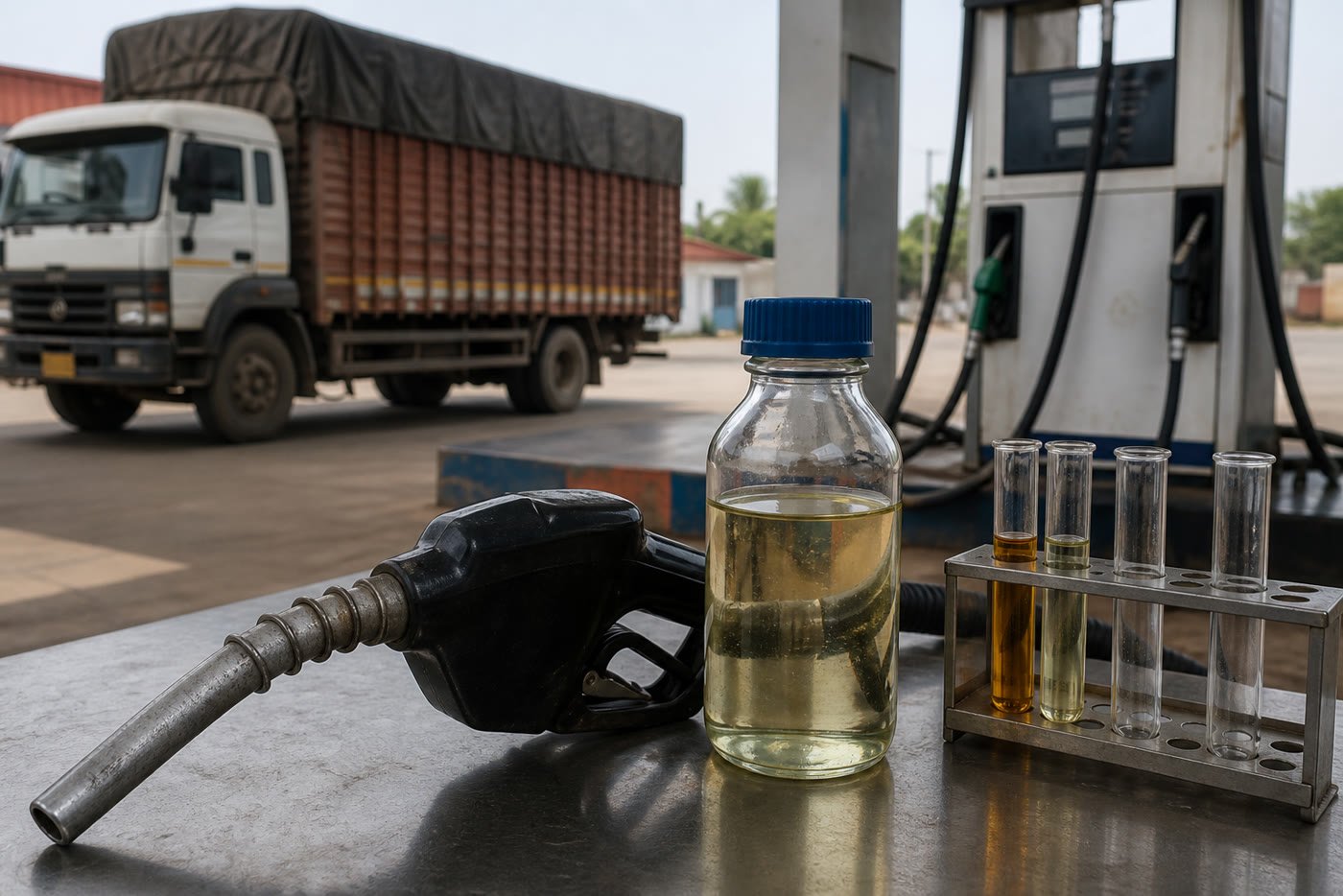
India's next major fuel-policy shift may come through diesel, not petrol. Recent reports citing Road Transport and Highways Secretary V. Umashankar say the government is taking isobutanol blending with diesel seriously and could bring a formal mandate later in 2026. For FuelPrice readers, this is a high-impact development because diesel sits at the centre of Indian freight, buses, agriculture equipment, construction movement and many older private vehicles.
The story matters more than a technical fuel update. Petrol users have already lived through E10, E20 and the policy push toward E85 and E100. Diesel users have not faced the same scale of alcohol-blending transition at the pump. If isobutanol is blended into diesel, the impact could reach truck operators, transport unions, state bus fleets, diesel SUV owners, farmers using tractors and fuel retailers who manage high-speed diesel storage and dispensing.
Sponsored
What Happened
Mint, Business Standard, Business Today, Economic Times and Financial Express have reported that India is likely to move toward a mandate for blending isobutanol with diesel as early as this year. The comments were made by MoRTH Secretary V. Umashankar at an industry logistics event, where the fuel shift was linked to energy security and decarbonising road transport.
The reports also note that Bharat Petroleum is undertaking strategic research on isobutanol blending with diesel, while the Automotive Research Association of India has been asked to study flex-fuel engines that can run on isobutanol-based alternatives. These are important details because they show that the proposal is not only a pump-side decision. It needs engine testing, emission validation, fuel-quality standards, vehicle-maker acceptance, retailer readiness and clear guidance for users.
Why Diesel Makes This Bigger Than Petrol
Diesel has a different economic role from petrol. Petrol is mostly linked to private cars and two-wheelers, while diesel is deeply tied to goods movement, public transport, mining, construction, tractors, intercity buses and long-haul trucking. Reports from the same industry event highlighted that diesel consumption is almost twice petrol consumption in India. That means even a modest diesel-blending mandate can have a wider logistics and import-bill impact than a similar petrol-only measure.
For the government, the attraction is clear. Blending a domestic biofuel component into diesel can support energy security, reduce crude-oil dependence and create a new market for biofuel producers if the supply chain is reliable. For fuel users, the attraction is not automatic. A mandate must prove that the blended fuel protects engine durability, does not create unexpected maintenance costs, and is priced in a way that does not raise the real cost per kilometre.
What Is Isobutanol And Why Use It In Diesel?
Isobutanol is an alcohol-based biofuel related to ethanol but with properties that make it relevant for diesel-blending research. It is being discussed as a possible alternative component for high-speed diesel because it can be produced from biomass routes and may help reduce fossil-fuel dependence. However, it is not the same as simply adding ethanol to petrol. Diesel engines work differently, and fuel quality affects ignition behaviour, injector performance, filters, emission systems and cold-start characteristics.
That is why the user-facing message should be conservative: no diesel owner should assume every existing vehicle is automatically ready for an isobutanol blend until the government, fuel companies and vehicle manufacturers specify the blend percentage, standards, testing results and warranty position. The mandate signal is important, but the final notification and technical limits will decide how it affects real vehicles.
Who Will Feel The Impact First?
| User group | Why it matters | What to watch |
|---|---|---|
| Truck and logistics fleets | Fuel cost per kilometre directly affects freight rates and operating margins. | Blend percentage, mileage impact, pump availability and engine warranty guidance. |
| Bus operators and state fleets | High daily diesel use makes even small efficiency or maintenance changes material. | Depot fuel standards, emission compliance and bulk procurement pricing. |
| Diesel-car and SUV owners | Older BS4 and current BS6 vehicles may need clear compatibility statements. | OEM advisories, service bulletins and any warranty exclusions. |
| Farm and construction users | Tractors, generators and machinery often operate in harsh conditions. | Storage stability, filter clogging risks and rural supply consistency. |
The Main User Concern: Running Cost
For diesel users, the practical question is simple: will blended diesel cost less, the same, or more per kilometre? Pump price alone is not enough. A trucker or diesel-car owner will judge the fuel by mileage, maintenance, downtime, filter performance and whether the vehicle continues to perform reliably under load. If the blend is priced attractively but reduces range or increases servicing, the saving can disappear. If it performs cleanly and is priced well, the policy could help users and reduce oil-import exposure at the same time.
This is also why rollout design matters. India may need a phased introduction rather than a sudden nationwide switch. Pilot corridors, controlled fleet trials, public test results and clear fuel-labelling rules would help reduce confusion. Fuel retailers also need clarity on storage, handling, quality checks and whether blended diesel will be sold universally or in selected markets first.
What Changes Now
Nothing changes at the pump for diesel users until a formal notification, blend specifications and supply plan are issued. The current development is a strong policy signal: after E20 petrol and draft provisions for higher ethanol and biodiesel fuel categories, the government is now looking at diesel as the next large fuel pool for substitution. Because diesel volumes are large, the stakes are higher and the testing burden is heavier.
Automakers will be watching closely. They need to know whether the final blend works with existing BS6 diesel systems, whether older vehicles need caution, and how to communicate compatibility to customers. Logistics companies will focus on total cost of ownership. Fuel companies will focus on supply, quality and blending economics. Consumers should wait for official blend percentages and OEM advisories before drawing conclusions about their own vehicles.
What To Watch Next
- Whether MoRTH or another authority issues a formal notification in 2026.
- The proposed isobutanol blend percentage for high-speed diesel.
- ARAI and oil-company test results on performance, emissions and durability.
- Whether vehicle makers issue compatibility and warranty guidance.
- How blended diesel is priced against regular diesel at the pump.
- Whether rollout starts with fleets, pilot corridors or a wider retail mandate.
Reader takeaway: isobutanol-diesel blending could become one of India's most consequential fuel-policy moves because it targets the country's diesel-heavy transport economy. The idea can support energy security, but users should judge it by validated engine compatibility, real cost per kilometre, pump availability and warranty clarity. Until the final notification arrives, diesel owners should treat the development as an important watchlist item, not an immediate change in what they can safely put in the tank.
Sources
- Mint: Diesel-isobutanol blending mandate likely this year
- Business Standard: Transport secretary on diesel-isobutanol mandate
- Business Today: MoRTH Secretary comments on blending mandate
- Economic Times: Notification on blending isobutanol with diesel
- Financial Express: Impact of isobutanol-blended diesel