India Resets Fuel Export Duties: SAED on Petrol Exports at Rs 3, Diesel and ATF Levies Cut from May 16
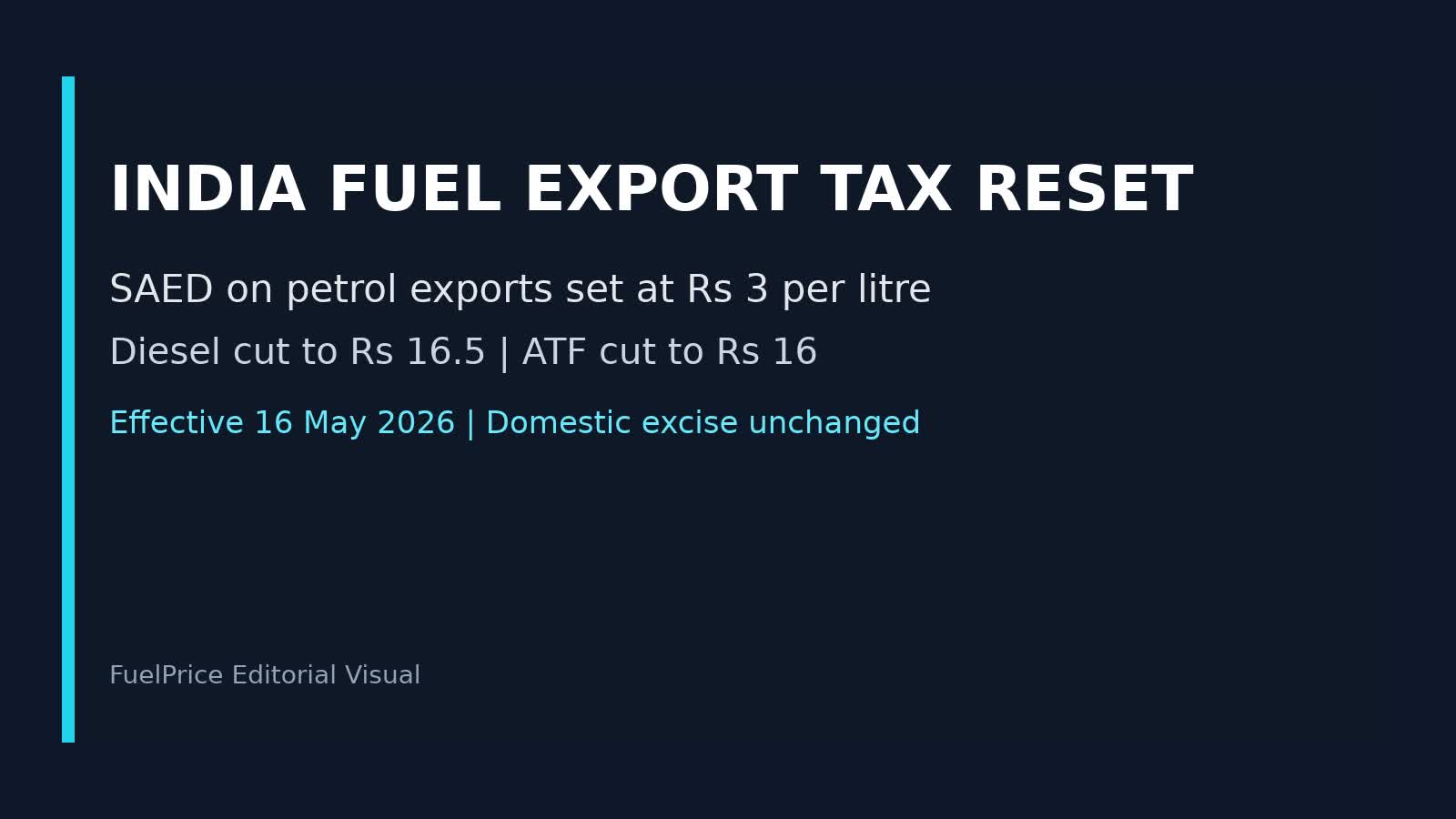
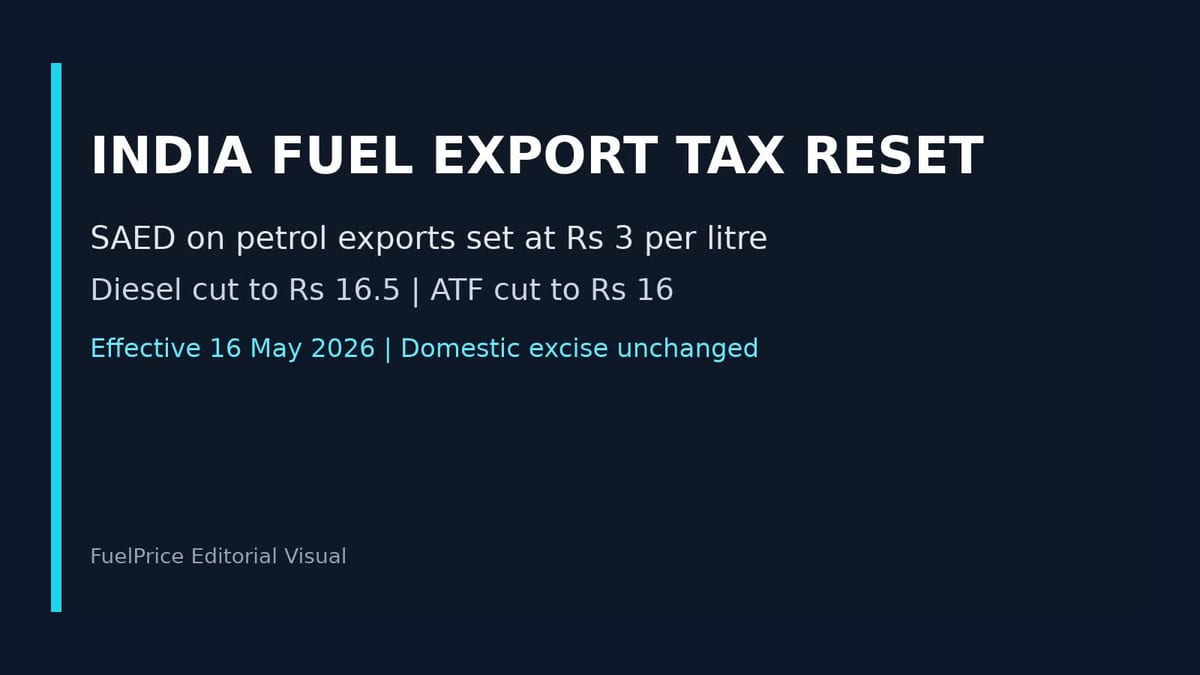
India has revised its fuel export duty structure effective 16 May 2026, imposing a Rs 3 per litre Special Additional Excise Duty (SAED) on petrol exports while cutting diesel and ATF levies to Rs 16.5 and Rs 16 per litre respectively.
The most important policy signal is the combination itself: a new petrol export duty plus lower diesel and ATF levies, while domestic excise duties on petrol and diesel remain unchanged. This is a calibrated export-policy move, not a direct retail fuel-tax revision for consumers.
Sponsored
Key Highlights
- SAED on petrol exports: Rs 3/litre (from nil).
- SAED on diesel exports: reduced to Rs 16.5/litre (from Rs 23/litre).
- SAED on ATF exports: reduced to Rs 16/litre (from Rs 33/litre).
- Road and Infrastructure Cess on petrol and diesel exports was reported as nil under the revised structure.
- No change was announced in domestic excise duty rates for petrol and diesel consumption in India.
What Changed in Policy Terms
The revision is part of India fortnightly duty review mechanism for petroleum exports. Instead of one-direction tightening or loosening, the government has used a mixed adjustment: introducing duty on petrol exports while reducing the burden on diesel and ATF exports.
| Product | Previous SAED | Revised SAED (from 16 May) | Immediate Market Meaning |
|---|---|---|---|
| Petrol export | Nil | Rs 3/litre | New export duty introduced |
| Diesel export | Rs 23/litre | Rs 16.5/litre | Levy eased |
| ATF export | Rs 33/litre | Rs 16/litre | Levy eased sharply |
Why This Matters
For FuelPrice readers, the practical point is that this is an upstream policy lever. It can influence refinery export incentives, product allocation and trade strategy before any direct retail pump-price effect appears.
In a volatile crude environment, export-duty calibration also helps the government balance three competing goals: domestic availability, inflation management, and revenue capture from export-linked margins.
Impact Lens: Users, Logistics and Market Watch
- Retail users: no immediate excise-duty change on domestic petrol and diesel was announced under this step.
- Transport and logistics: indirect impact depends on whether wholesale and freight-side fuel economics tighten or ease over the next duty cycle.
- Refining and trade: product-wise export realization changes can alter dispatch priorities and margins.
- Aviation value chain: lower ATF export levy can influence product-flow economics for refiners with export exposure.
What to Watch Next
- Next fortnightly SAED revision and whether petrol export duty is retained, raised or rolled back.
- Any spillover into domestic fuel pricing decisions by OMCs.
- Crude price trend and West Asia risk, which remain key drivers of duty recalibration.
- Refinery commentary on export-margin sensitivity under revised levy structure.
Final Takeaway
This revision is a high-signal policy move because it changes product-level export incentives without touching domestic excise rates. For readers tracking fuel outlook, the right approach is to monitor the full chain: crude trend, fortnightly SAED resets, and downstream pricing behaviour rather than any single announcement in isolation.
Sources Used
- DD News / News On Air (government broadcaster) update citing official gazette notifications, 16 May 2026
- Economic Times report on revised export duties, 16 May 2026
- India Today business report with ministry-rate details, 15 May 2026
- NDTV Profit report on SAED revision and fortnightly review cycle, 15 May 2026