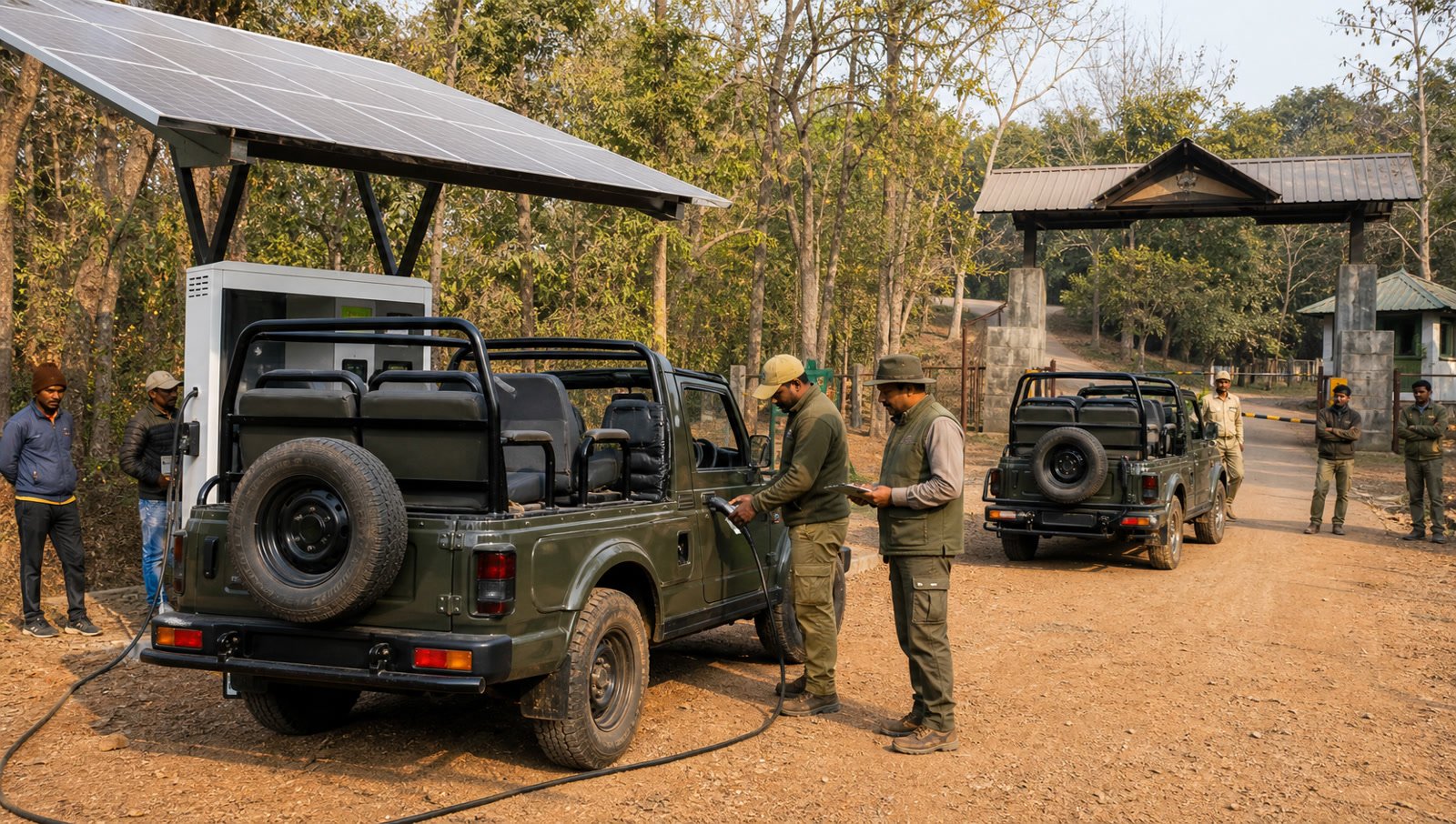
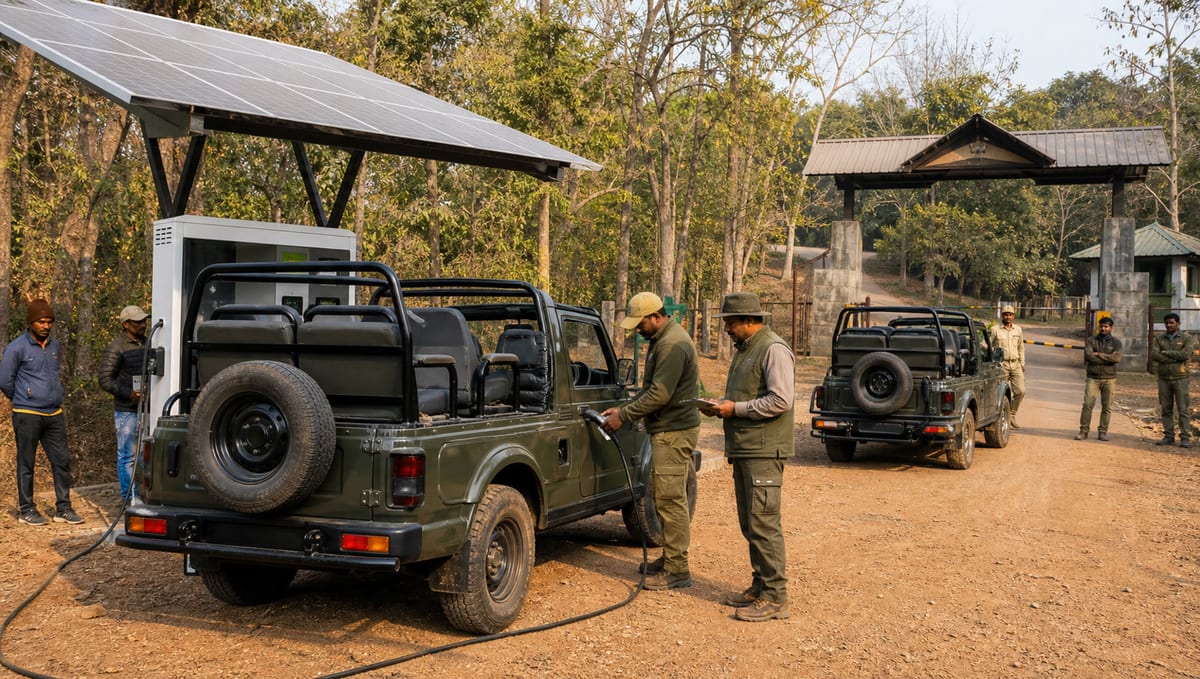
Maharashtra's forest vehicle fleet may be heading toward an electric transition, and the most sensitive part of that idea is not a city office car. It is the safari vehicle network inside tiger reserves, where fuel use, tourism income, conservation discipline and local livelihoods are tied together. Times of India reported that the Maharashtra forest department is actively considering a complete shift of its departmental fleet to electric vehicles, while also looking at a long-term plan to electrify safari vehicles inside tiger reserves.
The clearest fuel-use number comes from Tadoba-Andhari Tiger Reserve. According to the report, more than 300 petrol-run Gypsys are currently engaged in tourism inside TATR, and together they consume more than 1,000 litres of fuel daily. Each safari circuit is reported to average around 35 km. That makes the proposal a serious FuelPrice story: it connects government fleet policy, petrol demand, charging infrastructure, rural tourism operators and the economics of replacing ageing vehicles.
Sponsored
What is being considered
State forest minister Ganesh Naik told TOI that the department wants to respond to the Prime Minister's wider call to reduce fossil-fuel dependence. The departmental EV transition would cover vehicles used in field formations, including tiger reserves, territorial divisions and wildlife sanctuaries. However, the plan is still at the consultation stage and would need discussions with Maharashtra's transport department before rollout.
The safari-vehicle transition is even more complex. Naik described the move to electric safari vehicles as a long-term plan with no fixed timeline, because it involves multiple stakeholders. On the ground, sources cited by TOI said Tadoba-Andhari is preparing a proposal to shift all tourist vehicles operating inside the reserve to electric power. That proposal is expected to include financing options for local vehicle owners, with possible participation from state agencies, central agencies and private stakeholders.
Why the fuel impact matters
A daily consumption figure of over 1,000 litres is not minor for a single tourism ecosystem. If that level of petrol use continues across busy operating days, fuel becomes a recurring cost for drivers and owners, a local emissions source near forest gates, and a logistical dependency for a tourism model that is supposed to project low-impact nature travel. EVs would not remove all environmental questions, because electricity source, battery life and charging infrastructure matter. But they could reduce tailpipe emissions, engine noise and petrol dependence inside sensitive tourism zones.
The fuel argument also fits the national policy backdrop. Recent reporting on the Prime Minister's fuel-conservation push noted a smaller official convoy and a wider call for more electric vehicle adoption. Union minister Nitin Gadkari has separately described fossil-fuel imports as a major economic and pollution challenge, with India importing a large share of its petrol, diesel and gas needs. A forest fleet may be a small part of India's overall fuel market, but it carries high symbolic value because it operates inside conservation landscapes.
| Issue | Current pressure | EV transition question |
|---|---|---|
| Fuel use | Over 300 petrol Gypsys in Tadoba reportedly consume more than 1,000 litres daily. | Can EVs handle safari duty cycles reliably through peak tourism periods? |
| Operator cost | Petrol, repairs and ageing spares raise operating stress. | Will financing and subsidies make EVs affordable for local owners? |
| Tourism quality | Older vehicles can mean noise, maintenance issues and breakdown risk. | Can charging schedules work without reducing safari slots or livelihoods? |
| Conservation image | Petrol vehicles inside a reserve conflict with clean-tourism messaging. | Will the switch cut emissions without creating new waste or battery-management problems? |
The livelihood challenge
The biggest risk is affordability. The TOI report said a new electric vehicle suitable for this use could cost Rs 15 lakh or more. That is a heavy investment for safari operators, many of whom are from local and largely tribal communities dependent on wildlife tourism. A forced or poorly financed transition could hurt the very people who help run the reserve tourism economy.
That is why the financing structure matters as much as the vehicle technology. If the plan moves ahead, it will need low-cost loans, subsidy support, predictable bookings, charging access and clear maintenance arrangements. A safari owner will not judge the EV only by environmental benefit. The owner will calculate monthly instalments, daily trips, charging downtime, battery warranty, repair access and whether tourist demand stays stable.
Charging is the real test
An electric safari fleet cannot depend on scattered urban chargers. It needs chargers near reserve gates, parking areas and route-control points, with power backup or solar integration where possible. The image of a quiet EV in a forest is attractive, but the practical system behind it must handle early-morning departures, back-to-back safari slots, summer heat, monsoon disruption and remote service needs.
There is also a route question. A 35 km average circuit is not long by ordinary EV standards, but safari vehicles may operate repeatedly and carry passengers over rough terrain at low speeds. Battery performance, ground clearance, water resistance, suspension durability and quick service support will decide whether operators trust the technology.
Why Tadoba is an important test case
Tadoba is one of India's best-known wildlife tourism destinations, and recent TOI reporting shows the reserve is already experimenting with visitor experience beyond conventional safaris, including virtual reality nature education at entry points and local youth employment linked to tourism services. If a place like Tadoba can move toward cleaner safari mobility without damaging livelihoods, the model could influence other tiger reserves and sanctuaries.
The National Tiger Conservation Authority's own public material highlights that tiger reserves are not only wildlife zones but also landscapes where local livelihoods, monitoring, conflict mitigation and state-centre coordination matter. That is exactly why safari electrification cannot be treated as a simple vehicle replacement order. It has to be a mobility, energy, tourism and conservation policy package.
What to watch next
The next signals will be whether Tadoba-Andhari submits a detailed proposal, whether Maharashtra announces a pilot project, and whether any financing package is designed for existing petrol Gypsy owners. Watch for charging infrastructure tenders, approved EV specifications, operator consultations and trial runs before any full transition is announced.
For FuelPrice readers, the takeaway is clear: this is not just an EV story inside a forest. It is a fuel-use story with a livelihood constraint. A well-designed transition could cut petrol dependence, reduce noise and support cleaner tourism. A rushed transition could create cost pressure for local operators and operational headaches for reserve managers. The strongest version of the policy would phase in EVs with financing, charging, maintenance and route planning ready before owners are asked to replace their vehicles.
Sources: Times of India Nagpur, Times of India Auto, Times of India Nagpur fuel-import context, National Tiger Conservation Authority, Times of India Tadoba tourism context.