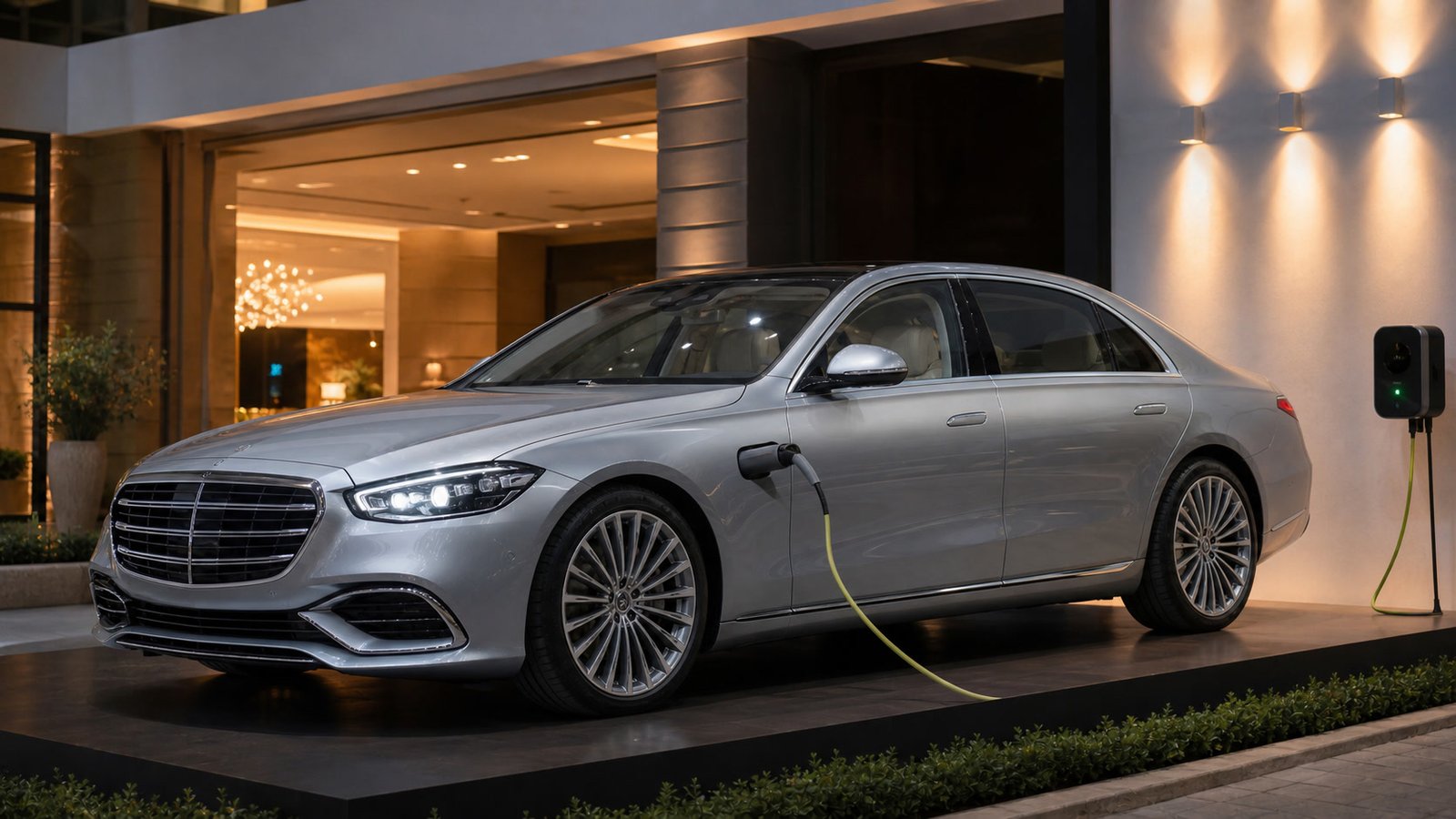
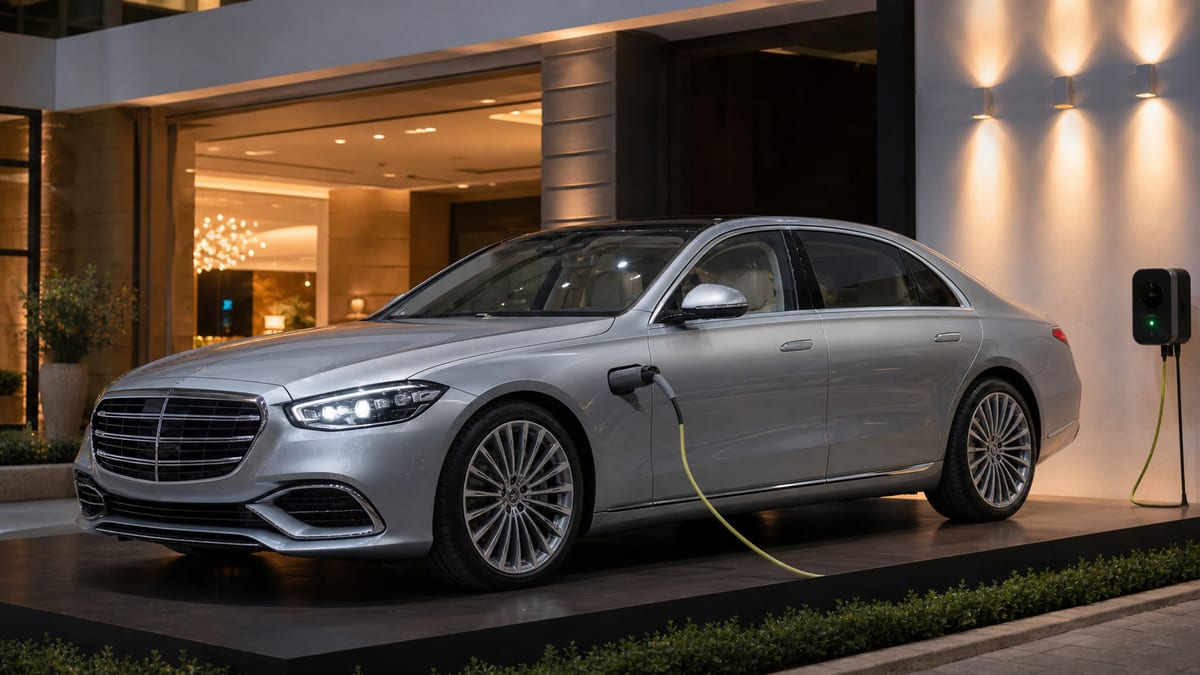
Mercedes-Benz India has taken one of its most important luxury-nameplate decisions in years: the 2026 S-Class is now available in India with the S 450e plug-in hybrid powertrain. For a sedan that has long been the default answer to the question, "What is the benchmark luxury limo?" the new variant changes the conversation by adding electrification without diluting the S-Class identity.
The launch is relevant for two reasons. First, it moves the flagship Mercedes closer to the direction premium car buyers are increasingly asking for: quieter running, lower daily fuel use and the option to drive short city distances on electric power alone. Second, it shows that the Indian luxury-car market is mature enough to support a plug-in hybrid sedan at the very top of the price pyramid. According to Economic Times, bookings are open now and deliveries are expected around Diwali 2026, which means Mercedes is not treating this as a concept or showcase product. It is a serious retail launch.
Sponsored
Price, variants and timing
The new S 450e arrives in two trims: the Launch Edition Exclusive Line at Rs 2.20 crore and the Manufaktur Edition AMG Line at Rs 2.38 crore, both ex-showroom. That places it well above mainstream luxury cars and firmly inside the ultra-luxury lane. The pricing also suggests that Mercedes is targeting buyers who want the latest S-Class tech and hybrid efficiency, not bargain-seekers.
Deliveries are scheduled to begin around Diwali 2026. That timing matters because the festive period is one of the strongest delivery windows in the premium-car business. It also gives Mercedes enough runway to build booking momentum and create a clear launch narrative around the plug-in hybrid system, the updated cabin and the refreshed styling.
| Launch detail | What Mercedes is offering | Why it matters |
|---|---|---|
| Variant range | S 450e Launch Edition Exclusive Line and Manufaktur Edition AMG Line | Helps Mercedes segment the flagship with different levels of exclusivity. |
| Price | Rs 2.20 crore to Rs 2.38 crore ex-showroom | Places the car in ultra-luxury territory with a PHEV twist. |
| Bookings | Open now | Signals Mercedes is ready for immediate customer interest. |
| Deliveries | Around Diwali 2026 | Adds urgency for premium buyers planning festive purchases. |
| Efficiency | About 32.2-32.33 kmpl WLTP | A rare headline number for a full-size luxury sedan. |
What makes the S 450e technically important
The S 450e is not a mild-hybrid badge exercise. It pairs a 3.0-litre turbocharged inline-six petrol engine with an electric motor and a 22 kWh battery pack. Mercedes says the combined output is 435 hp and 680 Nm, with drive routed through a nine-speed automatic gearbox. The 0-100 kmph sprint comes up in 5.7 seconds, which is very quick for a sedan of this size and class.
What matters more than the headline acceleration figure is the electric-only capability. Mercedes claims up to 115 km of pure electric range on the WLTP cycle. That means many city commutes, especially in premium-urban use cases, could be completed without firing the combustion engine. For a buyer who is often driven through traffic, attends short meetings across town or uses the car mainly for urban luxury duty, that kind of range turns the PHEV system from a talking point into a genuinely useful ownership feature.
The battery can charge from 10 to 80 percent in about 20 minutes on a 60 kW DC fast charger, which is a practical spec for the segment. It tells buyers that Mercedes expects real-world charging rather than treating the car as a token electrified model. In a market where many luxury buyers still want an engine and an exhaust note but also want lower daily fuel use, that balance is likely the central selling point.
Why this launch matters for India’s luxury market
The S-Class has always represented the top rung of luxury in India, but the market around it is changing. Premium buyers are increasingly aware of fuel efficiency, electrification and access to charging. A plug-in hybrid flagship lets Mercedes answer those concerns without asking customers to give up the traditional S-Class experience of space, rear-seat comfort and tech.
It also forces the competition to respond in a different way. Buyers comparing the BMW 7 Series, Audi A8 L or other full-size luxury offerings will now have to weigh a Mercedes product that combines flagship comfort with an electric commute window. In a segment where prestige and specification lists often matter more than outright mileage, a claimed 32.3 kmpl figure is still useful because it changes how the ownership conversation begins.
For the market, the message is broader. Mercedes-Benz is showing that India can support high-end electrified models, not just mass-market EVs or entry-level hybrids. That is an important signal because it means charging infrastructure, urban usage patterns and premium customer expectations are all mature enough to support more advanced powertrains at the top of the showroom ladder.
Design, cabin and comfort updates
Mercedes has also refreshed the S-Class with visible design changes. The front now gets twin three-pointed-star LED signatures, a larger illuminated grille and revised bumper details. The tail-lamps also carry updated star-themed graphics. These are not radical styling changes; they are the sort of subtle upgrades expected from a flagship facelift where restraint matters more than flash.
Inside, the 2026 S-Class gets Mercedes' latest MB.OS software, the MBUX Superscreen, Google Maps-based navigation and a more advanced AI-powered voice assistant. The car retains the long-wheelbase format in India, which is important because rear-seat comfort is central to the S-Class proposition. Mercedes says the four-seat configuration includes rear seats that recline up to 43.5 degrees, with heating, ventilation and massage functions available across all seats.
There is also a strong emphasis on ride quality and effortless control. AIRMATIC air suspension comes standard, and rear-axle steering is offered with a standard 4.5-degree setup that can be upgraded to 10 degrees. For a car of this size, that is not a gimmick. It changes how the car feels in tight city spaces and is exactly the kind of premium engineering detail flagship buyers expect.
Who will actually buy it
The real buyer profile is unlikely to be someone chasing mileage alone. It will be a combination of chauffeur-driven owners, business leaders, high-net-worth families and existing Mercedes customers moving up to the latest flagships. For these buyers, the car has to do three things at once: project status, remain comfortable in daily use and offer some forward-looking green-credential appeal. The S 450e tries to cover all three.
That is why the plug-in hybrid direction is strategically smart. It gives the car an efficiency story without forcing a full EV transition that some luxury buyers still are not ready to make. At the same time, it keeps Mercedes relevant in a luxury market where electrification is becoming a mark of modernity, not just compliance.
What to watch next
The immediate follow-up points are simple: how quickly bookings convert, whether the Manufaktur Edition gets stronger demand than expected, and how Mercedes positions the S 450e against the wider flagship-luxury field. It will also be important to watch real-world electric range once Indian customers start using the car in city traffic and mixed-condition driving.
Another key question is whether this launch opens the door for more plug-in hybrid or electrified Mercedes models in India at the top end. If the S 450e is well received, it can make a strong case for the idea that premium buyers in India are ready for expensive cars that are also meaningfully electrified.
The takeaway is straightforward. The new S-Class is not just a facelift; it is Mercedes-Benz bringing a serious plug-in hybrid flagship into India’s highest-value luxury sedan segment. For the right buyer, that combination of brand, comfort, technology and electric flexibility is exactly what a modern flagship should look like.
Sources: Times of India launch report, Economic Times launch report.