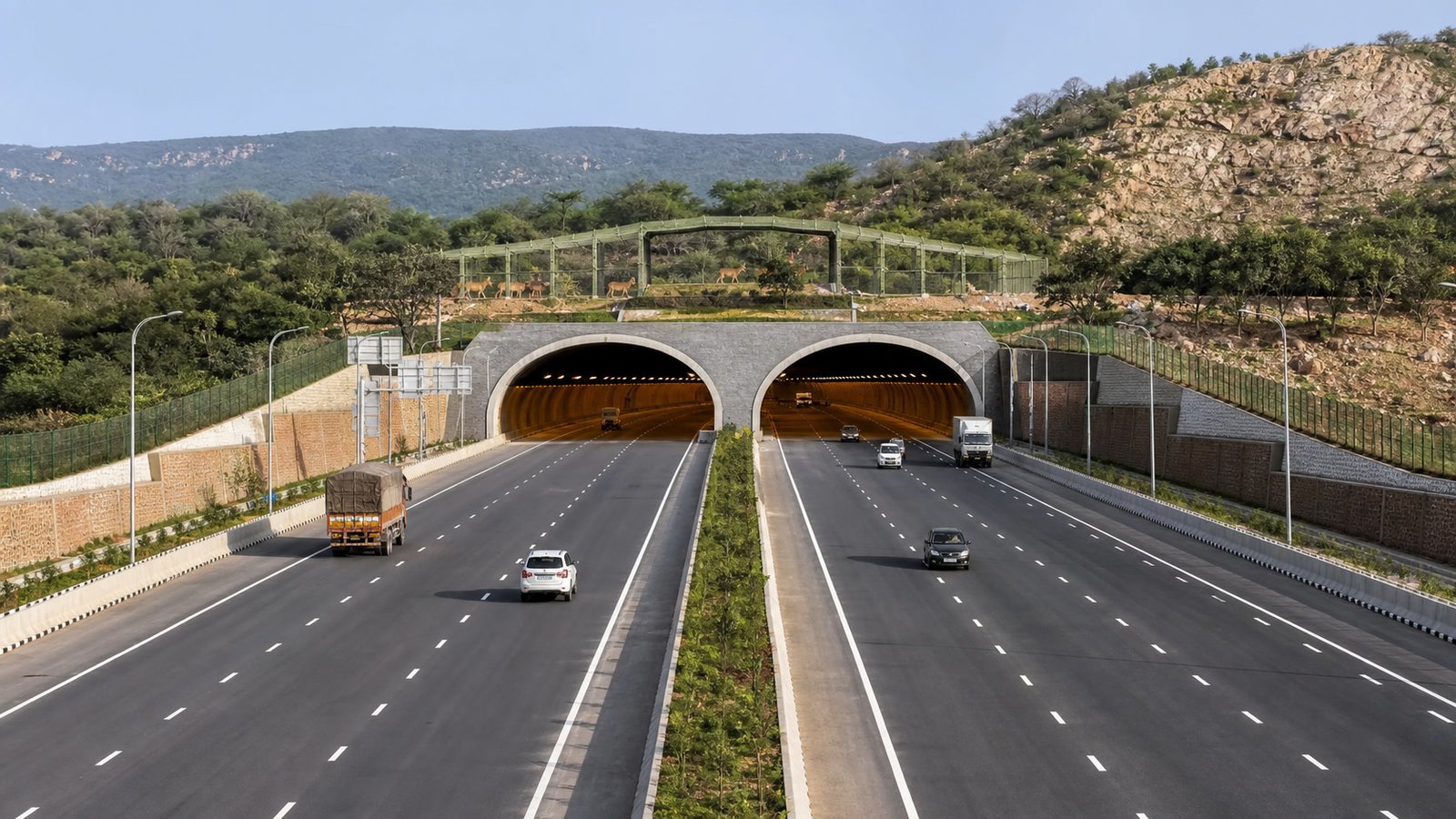
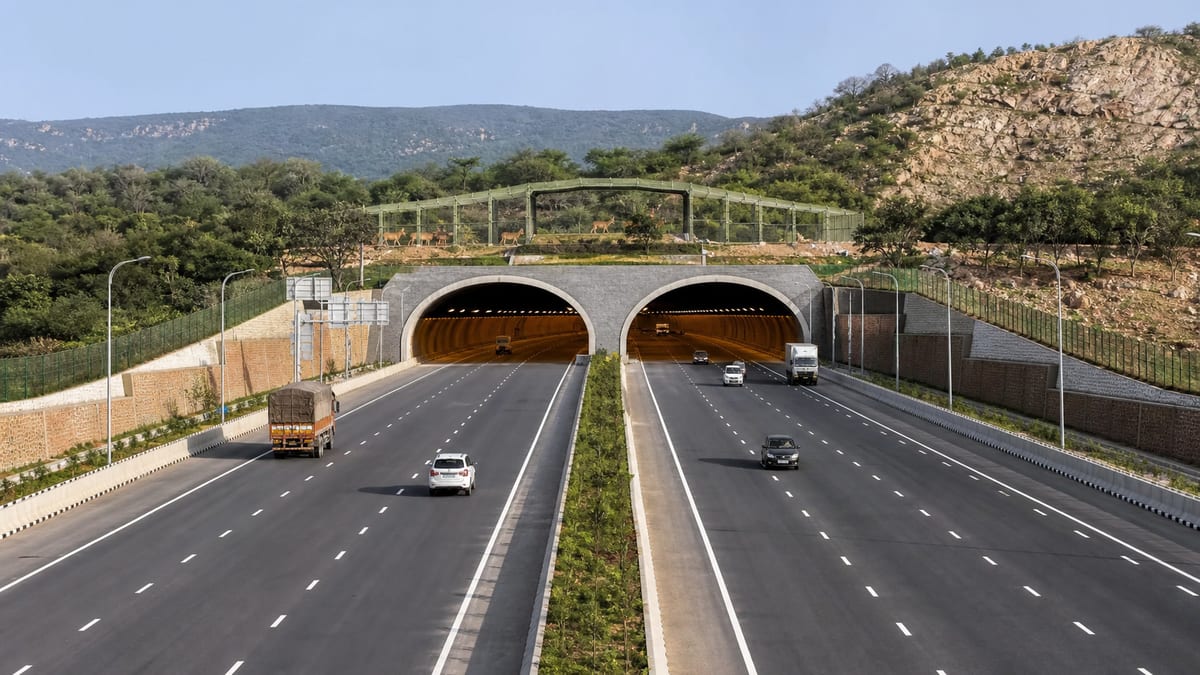
India is close to opening one of its most unusual highway assets: a 4.9-kilometre twin-tube, 8-lane tunnel under Rajasthan's Mukundra Hills Tiger Reserve on the Delhi-Mumbai Expressway. Times of India reported on June 14, 2026 that authorities are targeting June 20 for traffic opening after final safety clearances. The section sits near Kota and is part of the Delhi-Vadodara stretch of the larger expressway project.
For FuelPrice readers, this is not just an infrastructure milestone. It is a mobility-cost story. When a major expressway removes a winding hill section, the benefits show up in more than faster drives. They can appear in lower fuel burn per trip, fewer stop-start losses, more predictable freight schedules, safer vehicle movement and stronger route confidence for private car users, buses and logistics operators. At the same time, this tunnel matters because it takes a high-capacity road through an ecologically sensitive zone without forcing the usual surface-level fragmentation of wildlife habitat.
Sponsored
What exactly is opening
The upcoming section is being described as India's first 8-lane tunnel built beneath a tiger reserve. According to the June 14 TOI report, the tunnel runs below the Mukundra Hills Tiger Reserve near Kota and keeps traffic underground to reduce disruption to wildlife movement. The same report says the project was launched in 2019 and includes modern safety and monitoring infrastructure as part of the tunnel design.
The immediate practical change is simple: a difficult surface stretch around the hills is being replaced by a controlled expressway section. For motorists, that usually means fewer sharp speed changes, less braking on curves, fewer gear shifts for loaded vehicles and a more stable cruising pattern. For road transport, smoother alignment matters because fuel economy on highways depends heavily on rhythm. A truck or bus forced to slow, climb, brake and accelerate repeatedly will usually consume more fuel than one running on a straighter, more predictable corridor.
Why it matters for fuel use and logistics
The tunnel by itself will not change petrol or diesel prices at the pump. But it can change route economics. TOI reported in March 2026 that as Delhi-Mumbai Expressway work in Rajasthan nears completion, the eastern Rajasthan corridor is expected to cut the Dausa-Kota journey from about five hours to roughly two hours, while the Kota-Delhi trip could shrink from about nine hours to around five hours. The same report said NHAI officials expect fuel costs to come down because of the smoother corridor.
That matters for several user groups. A private car owner gains from reduced fatigue and better efficiency on long-distance drives. A bus operator gains tighter schedule control and less uncertainty in hill sections. A fleet owner gains from improved asset utilisation because trucks can complete more predictable turnarounds. A transporter moving time-sensitive goods, from FMCG loads to auto components, benefits when one of the remaining bottlenecks on a long corridor becomes less of a variable.
| Corridor indicator | Earlier travel profile | Expected impact after Rajasthan sections open |
|---|---|---|
| Dausa to Kota | Around 5 hours | About 2 hours, based on TOI's March 2026 Rajasthan progress report |
| Kota to Delhi | Around 9 hours | About 5 hours on the broader corridor, according to the same report |
| Mukundra hill crossing | Winding surface movement around the hills | Controlled twin-tube expressway tunnel with smoother flow and less route variability |
Note: the Dausa-Kota and Kota-Delhi estimates relate to the broader Rajasthan section of the Delhi-Mumbai Expressway, not only the tunnel in isolation.
Why highway users should treat this as a high-value mobility story
The Delhi-Mumbai Expressway is one of India's most ambitious road projects. TOI reported in December 2025 that the overall corridor is being developed at an estimated cost of about Rs 1 lakh crore and that multiple stretches are already operational. Even where the end-to-end route is not yet fully seamless, each opened segment changes how people and goods move. This is why the Mukundra tunnel matters beyond Kota. It improves continuity on a corridor that is supposed to connect important economic centres across Haryana, Rajasthan, Madhya Pradesh, Gujarat and Maharashtra.
For toll-paying users, the practical value lies in time reliability. Expressways justify their place in a travel budget when they deliver consistent speeds, lower vehicle stress and cleaner scheduling. For fleets, reliability often matters as much as pure speed because late arrivals ripple through warehouse slots, labour planning and return loads. For fuel users, a smoother stretch can be as meaningful as a marginal pump-price cut when the trip is long enough.
The conservation angle is not secondary
What makes this tunnel especially notable is that it avoids the crude trade-off of faster transport versus damaged habitat. The current TOI report says traffic will stay underground through the sensitive Mukundra zone to minimise disruption to wildlife movement. That is important because a standard surface alignment through a tiger-reserve landscape can fragment habitat, increase noise, create collision risks and complicate long-term conservation management.
This is also not a one-off design philosophy on the Delhi-Mumbai Expressway. In July 2025, TOI reported that NHAI had already built a 12-kilometre dedicated wildlife corridor on another Rajasthan section near the Ranthambore Tiger Reserve, with multiple wildlife overpasses, a long underpass, boundary walls, sound barriers and tree planting. The Mukundra tunnel fits into that broader pattern: the corridor is being engineered not only for vehicle throughput but also for ecological continuity. For policymakers and highway planners, that makes the project relevant far beyond Rajasthan.
Who benefits immediately
- Private car users: less tiring long-distance driving, more stable speeds and a cleaner route through the Kota region.
- Freight operators: better predictability through a previously sensitive section, which helps trip planning and fuel-cost control.
- Bus and tourist traffic: stronger route confidence for intercity and Rajasthan-bound travel.
- Regional tourism: improved access to Kota, Bundi, Ranthambore and nearby circuits can support higher road-based visitor flow.
- Infrastructure planners: a visible case study in building high-speed roads with conservation-sensitive design.
There is also a safety angle. TOI's March 2026 report on Rajasthan progress said the expressway is designed for speeds up to 120 km/h on the main corridor, although users will still need to follow posted limits and tunnel-specific controls. Controlled geometry, better lighting and monitoring can reduce the unpredictability that drivers often face on older hill alignments.
What to watch next
The first thing to watch is whether June 20 holds after final safety inspections. The current TOI report explicitly says travellers should check official traffic advisories because operational dates can still shift. The second is how smoothly the tunnel integrates with surrounding interchanges and live sections. A high-spec tunnel adds the most value when the approaches, signage, enforcement and traffic management are equally mature.
Users should also avoid over-reading the story. This opening does not mean the full Delhi-Mumbai journey instantly becomes frictionless on every remaining section, and it does not announce any separate toll revision in the available reports. What it does signal is that one of the most technically sensitive pieces of the corridor is close to going live, with direct implications for route quality, fuel efficiency and freight reliability.
The reader takeaway is clear. The Mukundra tunnel is a strong FuelPrice story because it sits at the meeting point of highway engineering, fuel economics, logistics efficiency and conservation policy. If the June 20 opening proceeds as targeted, motorists will gain a smoother and more efficient passage near Kota, fleets will get a more dependable corridor, and the Delhi-Mumbai Expressway will add one more piece of evidence that better road design can save time and fuel without treating ecological sensitivity as an afterthought.
Sources: Times of India June 14 tunnel opening report, Times of India March 2026 Rajasthan corridor progress report, Times of India wildlife corridor background report, Times of India Delhi-Mumbai Expressway project context.