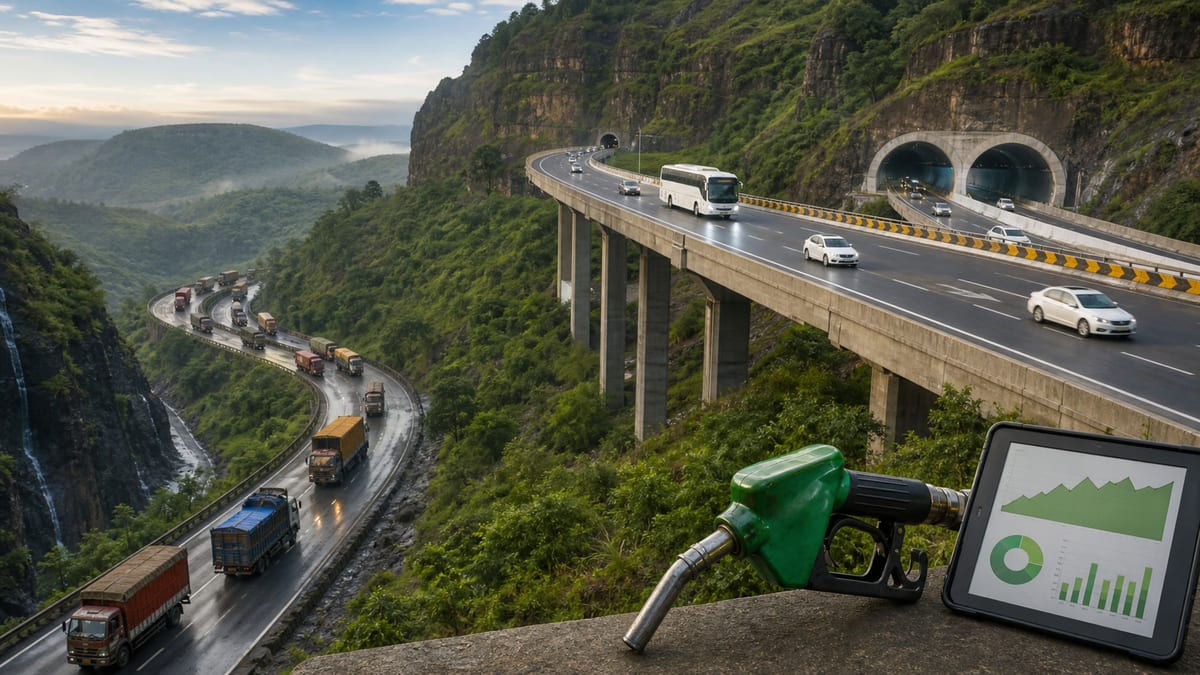
The Mumbai-Pune Expressway Missing Link is now producing a fuel story, not just a travel-time story. A new analysis by Pune-based fleet intelligence company Intangles estimates that commercial vehicle movement on the corridor could save about 2.7 crore litres of fuel a year, equal to around Rs 272 crore in annual fuel-cost reduction, after cars and passenger buses shifted to the new tunnel-and-viaduct bypass.
That is a high-value signal for FuelPrice readers because the benefit is not limited to private cars reaching Pune faster. The sharper impact is on freight movement through the Khandala-Bhor Ghat section, where trucks lose momentum on steep gradients, slow curves, lane interruptions and stop-go congestion. Even though heavy goods vehicles continue to use the older ghat road in the current phase, the removal of a large share of car and bus traffic has made the climb more predictable for commercial vehicles.
Sponsored
What Intangles measured
Autocar Professional reported on June 6, 2026 that Intangles built its estimate from 1,849 commercial vehicles and more than 2,200 trips through the ghat section. The company compared vehicle performance in the five days before the May 1 opening with the two weeks after the link became operational, using GPS, location data and vehicle fuel-consumption algorithms based on terrain and driving behaviour.
Financial Express reported the same fuel-savings estimate and noted that the analysis covered buses, medium commercial vehicles, three-axle vehicles and multi-axle trucks. The numbers show why infrastructure outcomes should be judged in operating terms, not only by ribbon-cutting dates. For a truck operator, a smoother climb means fewer gear drops, less hard braking, less fuel burned to regain speed, and a better chance of staying within a delivery window.
| Metric from reported analysis | Why it matters for fuel and logistics |
|---|---|
| 2.7 crore litres annual fuel savings potential | Shows a direct fuel-cost effect from smoother corridor movement. |
| Around Rs 272 crore annual fuel-cost reduction | Gives fleet operators a rupee-value benchmark for the corridor gain. |
| 64,905 tonnes annual CO2 reduction estimate | Links highway decongestion with measurable emissions benefit. |
| MCVs: 18 percent speed gain, 19 percent time reduction, 17 percent fuel-use reduction | Medium trucks appear to benefit strongly from fewer interruptions on the climb. |
| Buses: 24 percent lower fuel consumption per trip | Passenger transport operators could see operating-cost relief where services use the corridor regularly. |
Why trucks save fuel even when they are not on the new link
The key detail is counterintuitive. Heavy goods vehicles, trailers and hazardous-cargo carriers are still kept on the older ghat route, while cars and passenger buses use the Missing Link in the first phase. The savings come from traffic separation. When lighter vehicles leave the old ghat section, trucks face fewer sudden cuts, fewer speed disruptions and less bunching on inclines.
That matters because a loaded diesel truck climbing a ghat is most efficient when it can hold momentum. If a car slows in front of it, or a bus blocks a lane, the truck may drop to a lower gear and burn more diesel to climb back to speed. This is where a road project becomes a fuel policy story in practice. The Missing Link does not change diesel prices, but it can reduce the amount of diesel burned on one of Maharashtra's most important freight corridors.
Autocar Professional also highlighted possible gains beyond fuel: lower hard braking, less harsh acceleration, reduced driver fatigue and potential future reductions in tyre, gearbox, transmission and after-treatment stress. Those benefits need longer monitoring, but the early direction is important for fleet maintenance budgets.
The infrastructure behind the savings
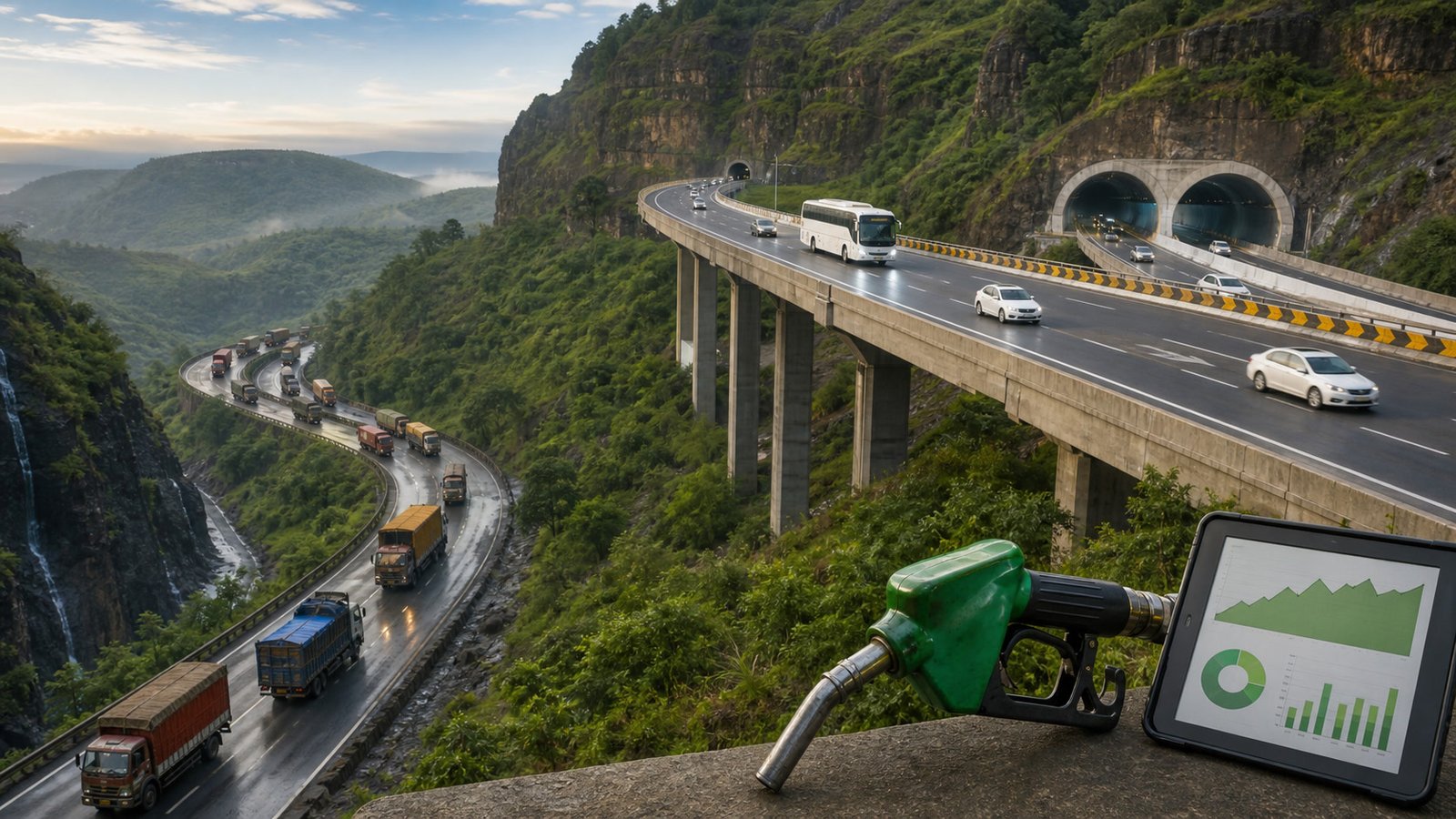
The Missing Link is a 13.3 km, eight-lane access-controlled alignment built by the Maharashtra State Road Development Corporation to bypass the steep and congested Bhor Ghat section near Khandala. The Indian Express reported that the project replaces a 19.8 km winding ghat stretch with viaducts, a cable-stayed bridge over Tiger Valley and twin tunnels through the Sahyadri hills. It cuts the Mumbai-Pune distance by around 6 km and is expected to reduce travel time by at least 30 minutes.
Financial Express reported at the opening that about Rs 7,180 crore had been invested in the project and that the link includes two tunnels, two viaducts and a cable-stayed bridge. The project has also been promoted as a wider economic multiplier because the Mumbai-Pune corridor supports freight, manufacturing, warehousing, e-commerce movement, intercity buses and daily business travel.
For fuel users, the most relevant part is not the record-setting tunnel width or bridge height by itself. It is how the new alignment changes traffic behaviour. A shorter, straighter, better-separated route reduces the number of conflict points where vehicles brake, crawl, idle and accelerate again. Those are the moments where diesel disappears without moving goods forward.
Who is affected
Fleet operators: Diesel is one of the largest variable costs in trucking. A measurable reduction on a high-frequency corridor can improve trip margins, especially for operators running multiple Mumbai-Pune or Mumbai-Pune-Bengaluru legs every week.
Drivers: Less stop-go movement on steep gradients can reduce fatigue and risky driving behaviour. This is not yet a full safety conclusion, but the early hard-braking signal matters.
Shippers and logistics buyers: More predictable travel time can reduce buffer time in dispatch planning. Faster turnaround can improve asset utilisation and may eventually reduce cost pressure in freight contracts.
Fuel users and consumers: Lower diesel burn by commercial vehicles does not immediately reduce pump prices, but it can soften transport-cost pressure for goods moving through the corridor. In inflation-sensitive supply chains, even small logistics savings matter when repeated across thousands of trips.
What changes now, and what to watch next
For now, the practical change is traffic separation. Cars and passenger buses get the faster new route, while freight vehicles gain breathing room on the old ghat section. The next test is what happens after the monsoon and whether authorities review access for goods vehicles, as reported by Autocar Professional. If truck categories are allowed onto the Missing Link later, the operating math could change again.
The second watch point is whether the fuel-savings trend holds over a longer period. The current analysis uses early before-and-after telemetry. A six-month dataset covering monsoon traffic, festive travel peaks, night freight operations and city-entry restrictions would give fleet owners a stronger benchmark.
The third watch point is toll and enforcement. Financial Express reported at the opening that no additional toll was imposed for now. If future toll policy changes, operators will compare toll outgo against fuel saved, time recovered and maintenance benefits.
Reader takeaway: The Mumbai-Pune Missing Link shows how highway design can work like an indirect fuel-efficiency intervention. By separating faster light traffic from freight traffic on a steep ghat corridor, the project may save diesel, reduce emissions and make fleet schedules more reliable without changing the price of fuel itself.
Sources
- Autocar Professional: Mumbai-Pune Missing Link fuel savings analysis
- Financial Express: Connecting Link boosts logistics speed and cuts transport costs
- The Indian Express: Missing Link opens to ease traffic
- The Indian Express: Missing Link route and tunnel explainer
- Financial Express: Missing Link project and economic multiplier context