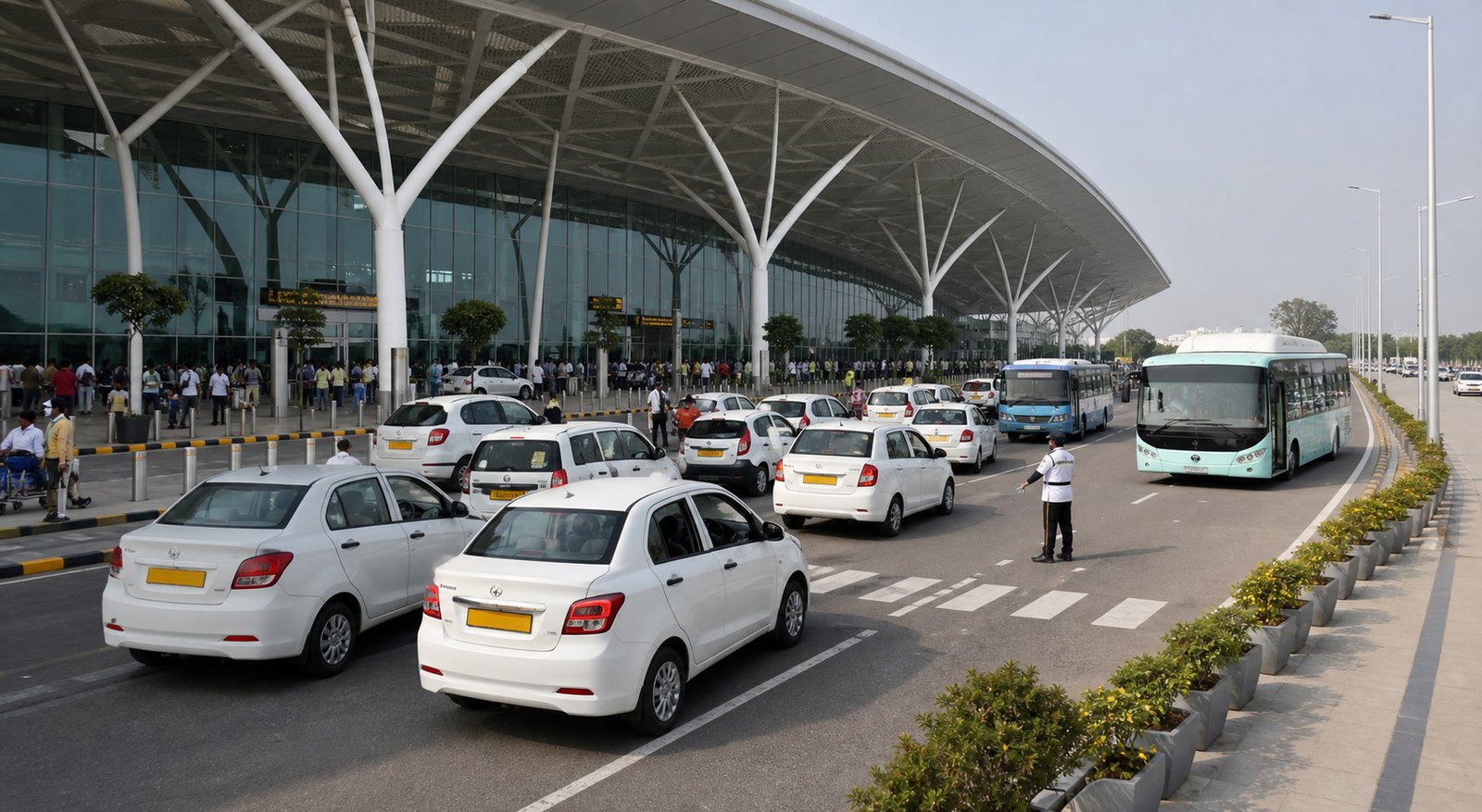
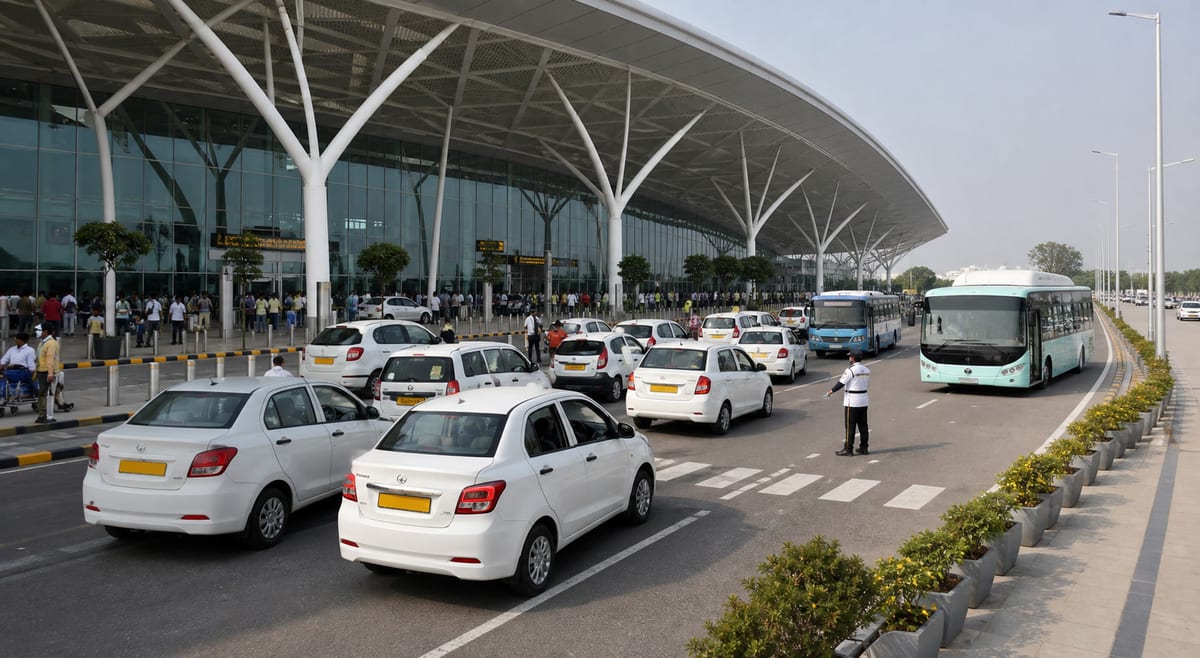
Noida International Airport's commercial opening on June 15, 2026 is a major infrastructure milestone for NCR and western Uttar Pradesh, but for FuelPrice readers the more immediate question is not only where flights are going. It is how people will get to the airport, how much that trip will cost, and whether the launch strengthens or softens road-fuel demand around one of north India's most important new mobility hubs.
On Monday, Times of India and Economic Times reported that Noida International Airport began commercial operations, with IndiGo's Lucknow flight becoming the first scheduled commercial arrival at Jewar. That confirms the airport is now live. But the airport's opening also brings a ground-access reality into focus: for many NCR users, especially from Noida and east Delhi, the first phase remains road-heavy even as a cleaner bus network is only starting to scale up.
Sponsored
What has opened now
TOI reported that flight operations started on June 15, with the first IndiGo commercial landing welcomed by a water-cannon salute. ET's launch-day report said the airport's initial schedule includes the Lucknow-Noida-Bengaluru pairing and the return Bengaluru-Noida-Lucknow service on the same day. ET also noted that the airport's first phase is built to handle roughly 12 million passengers annually and is expected to reduce pressure on Delhi's IGI Airport over time.
That scale matters because surface access becomes a cost and congestion issue very quickly once a new airport starts attracting regular passenger and staff movement. Airports are not isolated aviation assets. They are traffic generators. If the balance of access is too dependent on cabs and private vehicles, the user experience becomes more expensive and the broader mobility system becomes more fuel intensive.
Why the access story matters immediately
The launch-week warning came before opening day itself. On June 11, TOI reported that the only practical way to reach Noida International Airport for many users would be by cab or private car because metro links were missing and the city's proposed electric bus service was still catching up. The report placed the airport around 65 km from the populated parts of Noida and east Delhi, which are expected to be key catchment areas, and said app fares checked by TOI ranged from roughly Rs 800 to Rs 1,400 from Film City to the airport in Jewar.
That is the number ordinary travellers will understand first. Before they think about runway capacity or aerotropolis plans, they will think about whether the airport run adds a taxi bill that materially changes total trip cost. For a family, a solo budget flyer, an airport worker, or a frequent traveller making repeated city-airport trips, last-mile cost can heavily shape whether the airport feels convenient or merely operational.
The fuel angle is equally direct. A cab-heavy model means more road kilometres, more empty-return inefficiency for drivers, and greater dependence on expressway car traffic in the early phase. Even if part of the fleet shifts to electric taxis, the launch-day pattern is still more road-dominant than transit-dominant.
| Launch-day access factor | What the sources show | Why it matters |
|---|---|---|
| Commercial operations start | First IndiGo commercial arrival from Lucknow on June 15 | Passenger and staff trips become real daily traffic, not a future projection |
| Catchment distance | About 65 km from populated Noida and east Delhi areas, per TOI | Longer airport runs raise fare sensitivity and fuel exposure |
| Indicative app fares | TOI checked fares of about Rs 800-Rs 1,400 from Film City | Ground transport can become a large share of total travel cost |
| Cleaner bus rollout | 45 electric buses and 3 hydrogen buses flagged off on June 13; 110 e-buses to start with operations, per TOI | Cleaner shared transport can reduce future cab dependence and fuel burn if scaled well |
What the airport itself says about transport options
Noida International Airport's own passenger pages show that the operator understands the mobility challenge. The official NIA taxi page says the airport is offering airport taxis, app-based cabs and car rentals, and specifically mentions EV taxis with trained drivers, GPS tracking and multiple payment options. The same page lists app-based services such as OLA, Uber, Rapido and MakeMyTrip with dedicated pick-up and drop zones.
The airport's public-transport page also lists government and private bus options. It refers to UPSRTC connections across western Uttar Pradesh, DTC electric buses from major Delhi inter-state bus terminals, Haryana Roadways access from cities such as Gurgaon and Faridabad, and UTC connectivity from Uttarakhand. In other words, the airport is not presenting itself as cab-only. But the practical reader question is different: how mature, frequent and user-friendly will those options feel for actual launch-week passengers compared with simply booking a cab?
That distinction matters. On paper, multimodal access exists. In practice, adoption depends on route frequency, baggage friendliness, last-mile transfers, ticketing convenience, airport signage and whether travellers trust the system enough to use it for early-morning or late-night flights.
Why the electric and hydrogen bus rollout still matters
The cleaner-mobility part of this story is not cosmetic. On June 13, TOI reported that chief minister Yogi Adityanath virtually flagged off 45 electric buses and 3 hydrogen buses for Noida, Greater Noida and Yamuna City ahead of the airport's launch. The report said 110 electric buses would start operation from Monday and the network would gradually expand to 500 buses. It also said the buses would initially operate within the three authority areas while connecting passengers to the airport and Ghaziabad bus depot.
That is important because it shows the state is trying to solve the airport-access problem with cleaner shared transport rather than only more fossil-fuelled road demand. The hydrogen buses have an indicated range of up to 750 km on one refill, according to TOI, while the electric fleet is positioned as a scalable last-mile connector. If this network grows reliably, the airport's access pattern can shift away from being dominated by single-car and two-way taxi movements.
For FuelPrice readers, the real significance is not whether every passenger takes a bus on day one. It is whether the airport corridor becomes an example of mobility demand being met with cleaner fleets early, before traffic habits harden around private cars and cabs. Once a major airport becomes structurally cab dependent, undoing that pattern is costly and slow.
Who is affected first
- Passengers: They face the immediate trade-off between convenience and ground-trip cost, especially on 60-plus-km airport runs.
- Cab operators and aggregators: Opening-day demand can create a strong new route market, but return-load uncertainty and fare sensitivity still matter.
- Airport employees: Regular commuting economics are more critical for staff than for occasional flyers, making bus reliability essential.
- Expressway users: More airport-bound car traffic can add pressure to road corridors even when flight volumes are still ramping up.
- State transport planners: They need the EV and hydrogen fleet to become a real mode choice, not only a symbolic launch asset.
What changes now, and what to watch next
The airport opening means the mobility experiment has moved from planning to operations. Travellers will quickly test whether official bus links are easy to find and practical to use, whether EV taxi supply is adequate, and whether app fares stabilise or spike during peak slots. The next few weeks will show whether buses can absorb meaningful demand or whether cabs continue to dominate by default.
The most important signals to watch are straightforward. One, how visible and frequent the airport bus services become. Two, whether the EV taxi offering grows beyond a niche option. Three, whether metro and stronger fixed-transit integration move from promise to timeline. Four, whether airport workers and frequent flyers actually shift to shared transport. Five, whether launch-week fare levels settle into something competitive enough to keep the airport attractive for ordinary users.
The reader takeaway is clear. Noida International Airport's opening is a big aviation win, but its near-term transport economics are still being written on the road. The official system already offers cabs, EV taxis and public bus partners, while Uttar Pradesh has started rolling out electric and hydrogen buses to strengthen the corridor. The real test now is execution: if shared clean mobility becomes dependable quickly, the airport can cut congestion and fuel intensity. If not, road-heavy access will keep adding cost and traffic to every trip long after the inaugural water-cannon salute fades.
Sources: Times of India June 15, 2026 launch report, Economic Times June 15, 2026 operations and schedule report, Times of India June 11, 2026 access and fare report, Times of India June 13, 2026 EV and hydrogen bus rollout report, Noida International Airport taxi page, Noida International Airport public transport page.