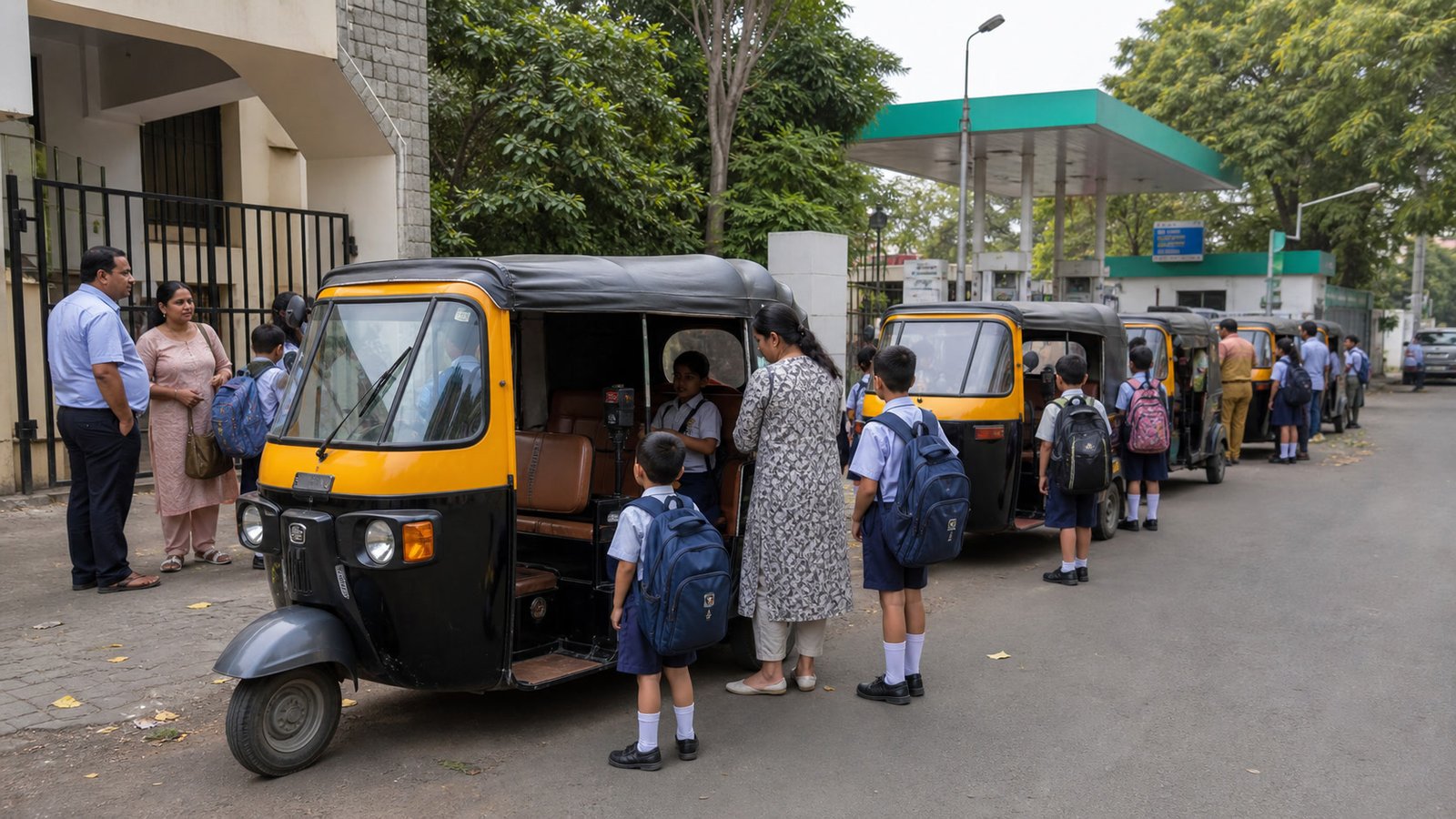
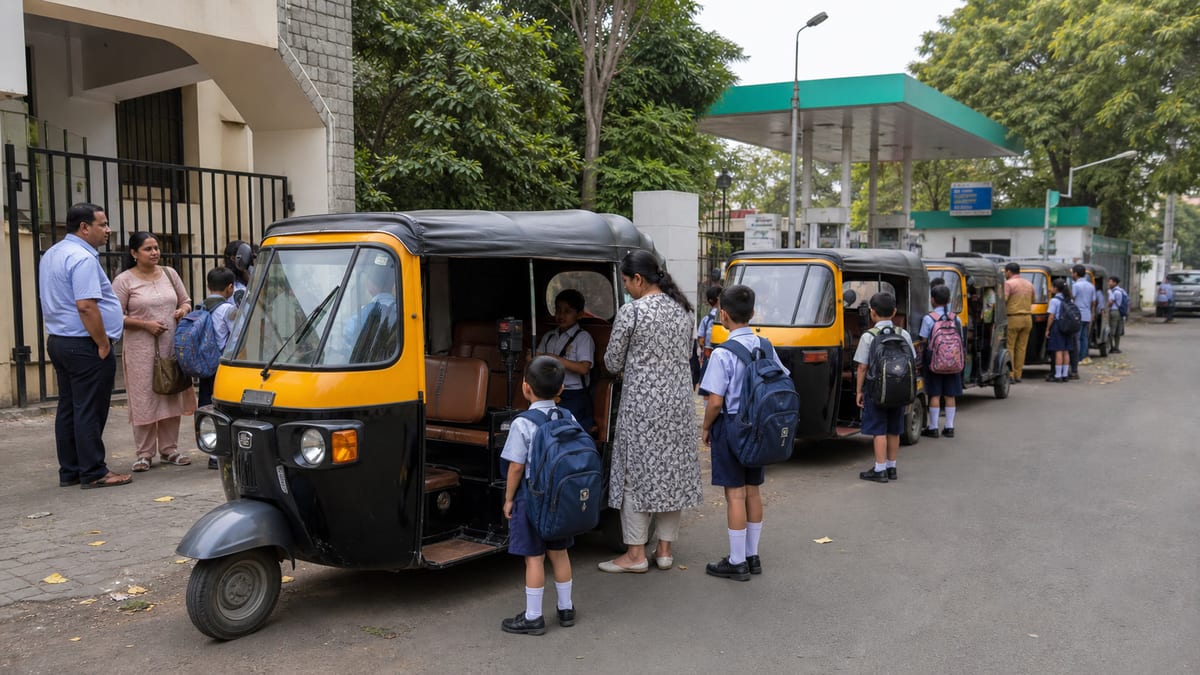
Pune's latest transport-cost dispute is playing out where fuel inflation becomes most visible for households: the daily school ride. Times of India reported on June 14, 2026 that autorickshaw drivers ferrying school students are demanding a fare hike after recent CNG price increases, while parents are resisting another rise in monthly transport payments. For FuelPrice readers, this is a high-value mobility story because it shows how a relatively small per-kilogram fuel revision can move through the system and hit families as a repeated, unavoidable monthly expense.
This is also not an isolated protest. Over the past two weeks, Pune has already seen multiple signs that fuel-cost pressure is being pushed into passenger fares. TOI reported on May 28 that Maharashtra Natural Gas Ltd raised the CNG price in Pune by Rs 2.50 per kilogram to Rs 94.75 from Rs 92.25, citing higher input costs. On June 9, autorickshaw unions in Pune pressed for an increase in city fares. On June 12, prepaid autorickshaw fares from Pune airport were raised by Rs 20. The June 14 school-auto dispute is therefore best understood as part of a broader pass-through cycle, not a one-day local argument.
Sponsored
What happened now
The immediate trigger is simple: school-trip autorickshaw drivers say rising CNG costs have made the current pricing structure hard to sustain, especially for operators carrying children on fixed morning and afternoon routes. Parents, on the other hand, are pushing back because school transport is not a discretionary spend. Once a child is enrolled and the route is set, the family usually has to keep paying unless it has another practical travel option.
The timing matters. June is when school travel costs become visible again after the break, and families are already dealing with fees, uniforms, books and transport planning. That makes any fare revision more sensitive than a one-off airport trip. A Rs 20 or Rs 30 change on a single ride is one thing. A higher recurring monthly school-auto charge affects household budgeting every month.
Why the CNG hike matters even when gas is still cheaper than petrol
The May 28 TOI report on the MNGL revision said CNG still offers roughly 48% savings over petrol and about 26% over diesel for passenger cars, while autorickshaw operating economics also remain better on gas than on liquid fuels. That might suggest drivers should be able to absorb the hike. In practice, the calculation is different for a high-utilisation auto-rickshaw that runs multiple trips every day and earns on thin margins.
School-trip drivers do not only bear the fuel bill. They also absorb idle time, route delays, maintenance, traffic congestion, and time lost at filling stations. If the fuel price rises, even by a few rupees per kilogram, the impact compounds when the vehicle is refuelled repeatedly over a month. A school-route operator cannot easily add more rides in the morning peak to offset this, because the travel window is fixed by school timings. That is why small fuel revisions often produce outsized pressure in tightly scheduled urban transport segments.
| Cost indicator | Current reference point | Why it matters |
|---|---|---|
| Pune CNG rate | Rs 94.75/kg after the May 28 MNGL hike, up from Rs 92.25/kg | Higher per-kg gas cost directly squeezes daily school-route margins |
| Current city auto fare benchmark | Rs 25 for the first 1.5 km and Rs 17 for every additional km, according to union demands reported on June 9 | Shows the base pricing environment from which school-trip negotiations are being made |
| Recent visible pass-through | Prepaid Pune airport autorickshaw fares raised by Rs 20 on June 12 | Confirms that fuel pressure is already translating into passenger-fare adjustments |
| Vehicle base | More than 1 lakh autorickshaws in Pune and about 45,000 in Pimpri Chinchwad, per union reporting | Even local fare changes can affect a large commuting ecosystem |
Why queues and refuelling delays make the problem worse
Fuel cost is only part of the story. TOI reported in November 2025 that Pune and Pimpri Chinchwad had 184 CNG stations for roughly 6.63 lakh CNG and bi-fuel vehicles, including cars, autorickshaws and buses. That report also said many drivers lose one to two hours in refuelling queues. For school-auto drivers, that hidden cost is significant. Time spent waiting for gas is time not spent on earning trips, vehicle maintenance, or rest between shifts.
So the fare-pressure argument has two layers. First, the per-unit cost of fuel has risen. Second, the real operating cost of using that fuel remains elevated because access to it is not frictionless. For a parent, the visible issue is a request for higher monthly charges. For the driver, the issue is that fuel costs and refuelling downtime are both being compressed into a business model that cannot stretch much further without fare revision.
Who is affected
- Families: school transport is a recurring household cost, so any hike becomes part of the monthly education bill.
- Autorickshaw drivers: they face higher gas costs, refuelling queues and limited ability to widen margins on fixed school routes.
- Schools and transport coordinators: disputes over transport charges can spill into route planning, timing and parent complaints.
- Urban traffic: if more families withdraw from shared school autos and shift to private two-wheelers or cars, congestion and fuel use can rise elsewhere.
That last point matters more than it first appears. Shared school autos are a low-cost mass-mobility layer for urban India. If their economics weaken too much, parents may not get a cheaper alternative; they may simply get a less efficient one. In that sense, the story is also about preserving affordable shared mobility in a city where traffic and fuel use are already under strain.
What changes now
There is no evidence in the available reporting that a fresh citywide school-auto fare formula has already been formally approved. That distinction is important. The June 14 story is about drivers demanding a hike, not a final notified increase. But the direction of pressure is clear. The union push on June 9 and the airport prepaid revision on June 12 show that operators are actively trying to reprice services after the gas hike.
For parents, that means the current dispute may not be the end of it. Even if school-trip fares do not change immediately across the board, operators and route aggregators are likely to keep pressing for an adjustment if CNG remains near current levels or rises further. For drivers, the next few weeks may determine whether they can stabilise route economics without losing customers.
What to watch next
The most important next markers are whether transport authorities or local unions propose a clearer rate framework for school trips, whether CNG prices see another revision, and whether Pune expands refuelling capacity enough to cut queue time. Also watch whether more fare changes appear in other fixed-route urban transport segments. When airport, city and school-trip auto fares all come under pressure in the same period, it usually signals a broader operating-cost reset rather than a one-off protest.
The reader takeaway is direct. Pune's school-auto dispute is a clean example of how fuel policy and fuel pricing reach the household level. A Rs 2.50-per-kg CNG hike does not sound dramatic in isolation, but for high-frequency shared transport it can set off a chain reaction: thinner driver margins, fare demands, parent resistance and wider urban mobility stress. For FuelPrice readers, that is the real story. Fuel inflation does not stop at the pump. It eventually lands in the school commute, the airport ride, the monthly transport budget and the day-to-day economics of getting around the city.
Sources: Times of India June 14 school-auto fare report, Times of India June 9 union fare-demand report, Times of India June 12 airport fare report, Times of India May 28 MNGL CNG price report, Times of India CNG station-queue background report.