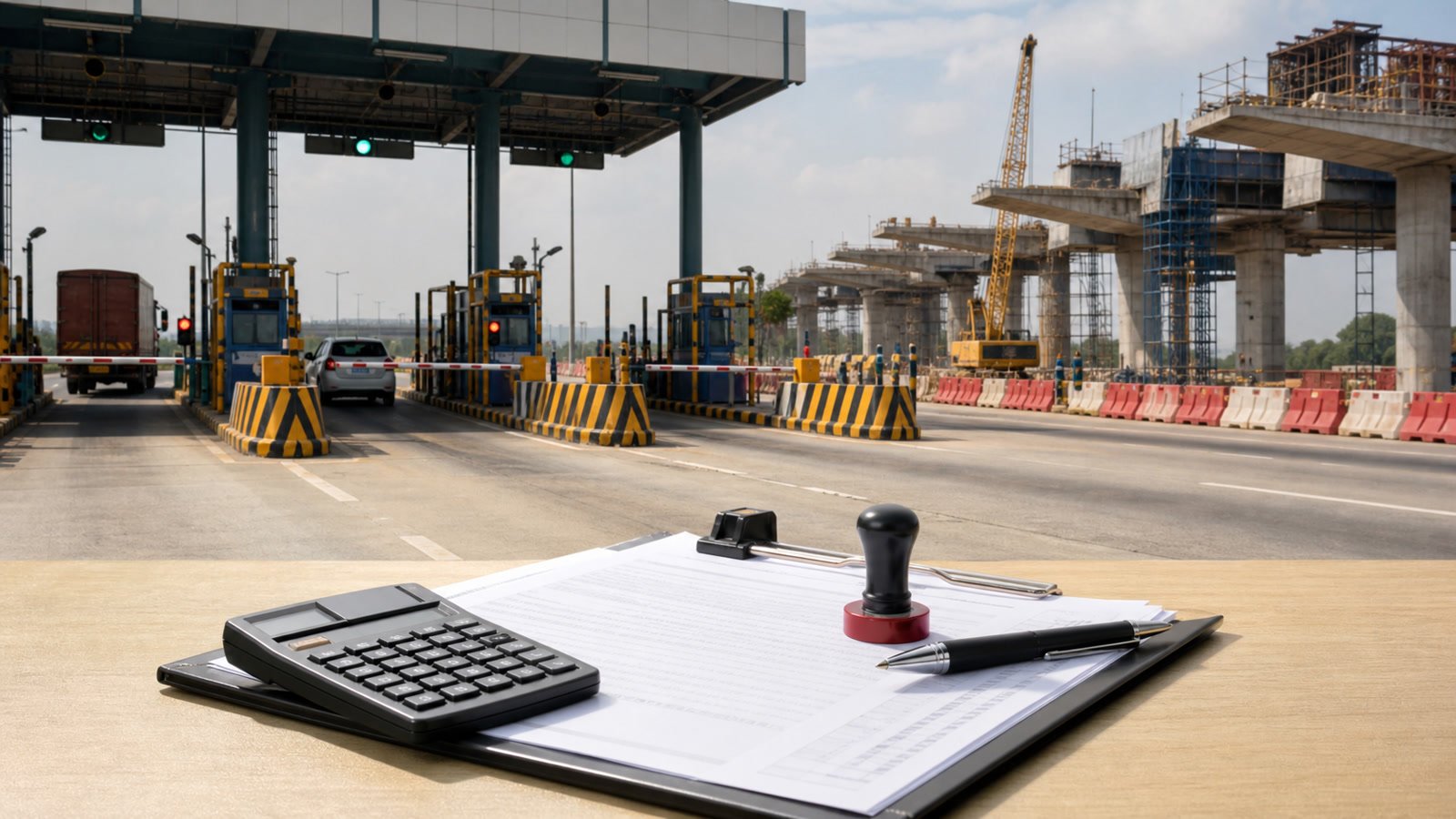
A Rajasthan High Court ruling has put a sharper tax lens on how highway concessions are structured when a developer builds road infrastructure for the National Highways Authority of India and receives the right to collect toll as part of the commercial arrangement. According to Economic Times, the court held that toll collection rights granted under a highway concession agreement can constitute taxable consideration for construction services provided to NHAI. The court dismissed the appeal by CG Tollway, which had challenged earlier authority orders on the issue.
For everyday motorists, the most important point is also the easiest to miss: this is not a direct order raising toll rates at plazas, nor does it say that a FASTag payment by a road user is suddenly a new tax bill. The issue is narrower and more technical. It concerns whether the right to collect toll, when granted to a concessionaire as compensation for building or upgrading a highway, should be treated as consideration for the construction service supplied to NHAI. In that setting, the court has backed taxability.
Sponsored
What the court has clarified
The case turns on the difference between a toll paid by a road user for access to a road and a toll-collection right used inside a concession contract. Toll payments by commuters are commonly understood as access charges for using a road or bridge. The dispute before the court was not simply about that retail payment. It was about the commercial value of a right that lets a concessionaire recover money from future toll collections after performing construction work for NHAI.
Economic Times reported that the Rajasthan High Court considered the earlier advance ruling chain and found that the toll collection rights were not exempt merely because toll collection itself has a special GST treatment in normal road-access use. In plain language, if a developer builds the road and is compensated through the right to collect toll, the tax department can view that right as payment for the construction service. That distinction is why the ruling matters beyond one project.
Why this matters for highway economics
Highway projects depend on long-term assumptions. Developers bid by estimating construction cost, traffic growth, toll collection potential, financing cost, maintenance expense, tax exposure and legal risk. If the tax treatment of toll rights is uncertain, the bid price changes. Lenders may demand more protection. Developers may build tax buffers into future offers. NHAI may also need to make concession documents clearer so that bidders know who carries the GST risk and how contract value is to be measured.
The timing is important because toll-linked asset monetisation remains central to India's highway funding strategy. On June 10, NHAI started its FY27 asset monetisation exercise by opening bids for two Tamil Nadu national highway stretches totalling 170 km under the toll-operate-transfer model, according to Economic Times. In late May, NHAI also said it had identified 17 highway assets covering 1,692.5 km for monetisation in FY27 through TOT and InvIT routes. Separately, NHAI said it raised Rs 28,307 crore through monetisation in 2025-26, including Rs 3,087 crore from TOT Bundle-18 and Rs 6,366.98 crore through InvIT Round-5.
Those numbers show why a tax ruling on toll rights is not just a courtroom footnote. Toll rights are a major financial tool. They help convert operational or concessioned road assets into funds for new highways, debt service and capacity expansion. Any legal clarity that changes how concession value is taxed can influence the return calculation for investors, the risk premium for future bids and the way concessionaires price projects.
Who is affected first
The immediate audience is not the private car owner at a toll booth. The first affected groups are highway concessionaires, construction companies, tax teams, infrastructure funds, lenders and public agencies involved in concession design. They will need to review how existing contracts describe consideration, toll rights, construction obligations and tax liability.
Transporters and logistics firms are affected more indirectly. Truck operators care about toll rates, route efficiency, fuel burn, waiting time and freight cost. A tax dispute at concession level does not automatically change tomorrow's toll receipt. But if higher tax exposure becomes a recurring cost in future road bids, developers may seek stronger contract protection or better returns. Over time, that can feed into project economics, toll expectations or viability discussions, especially on high-traffic corridors where freight movement is heavy.
| Stakeholder | Immediate meaning | What to watch |
|---|---|---|
| Highway developers | Toll rights used as project consideration may carry GST exposure. | Contract tax clauses, accounting treatment and appeal strategy. |
| NHAI and project authorities | Concession documents may need sharper tax-risk allocation. | Future TOT, BOT and hybrid contract language. |
| Lenders and investors | Cash-flow models may need a tax-risk buffer. | Bid pricing, returns and dispute reserves. |
| Transporters and road users | No immediate consumer toll change follows from the ruling alone. | Long-term bid economics and toll policy response. |
Why FuelPrice readers should care
FuelPrice readers usually track pump prices, toll charges, vehicle running cost and policy changes. This ruling sits at the back end of that cost chain. A highway toll bill is only one visible part of road travel cost. Behind it are construction finance, concession contracts, tax assumptions, maintenance obligations and traffic projections. When any of those inputs becomes more expensive or legally uncertain, the effect may not be immediate, but it can influence how roads are bid, funded and operated.
For freight operators, the link is even clearer. Long-haul truck economics already combine diesel cost, driver cost, finance, insurance, maintenance, compliance and toll outgo. If future highway concessions price in higher tax risk, logistics companies will watch whether that risk ultimately shows up in route economics or toll policy. The immediate answer is no automatic pass-through. The medium-term question is whether developers and authorities adjust future concession terms to avoid uncertainty.
What changes now
The ruling gives tax authorities stronger support in similar concession structures, but it is not the final word for every road project. Contract wording matters. The exact nature of the concession, the service supplied, the consideration received, and any later appeal will matter. Developers with comparable arrangements are likely to revisit legal opinions and tax provisioning. NHAI and bidders may also look for cleaner drafting in upcoming projects so that disputes do not emerge after financial closure.
There is also a communication challenge. If the ruling is discussed loosely as "GST on toll", it can confuse road users. The better reading is more precise: the court focused on toll collection rights granted as consideration for construction services under a concession arrangement. That precision matters because public reaction to toll taxation can be sensitive, especially when commuters already face annual toll revisions, congestion at plazas and rising transport costs.
What to watch next
The first watch point is whether the matter moves to the Supreme Court or whether similar disputes arise in other states and contracts. The second is whether CBIC or the GST Council offers further clarity for toll-right concession structures. The third is how NHAI's FY27 monetisation pipeline prices risk after this ruling, particularly as new TOT and InvIT assets come to market.
The reader takeaway is practical: do not treat this as an immediate toll hike story, but do not ignore it either. It is a cost-structure and contract-risk story. If toll rights are used as payment for highway construction, tax clarity affects the economics of the project. That, in turn, can shape future highway bids, infrastructure investor appetite and the long-term cost environment for India's road transport network.
Sources: Economic Times on the Rajasthan HC ruling, Economic Times on NHAI FY27 TOT bids, Economic Times on 17 FY27 highway assets, Economic Times on FY26 NHAI monetisation receipts, Times of India on toll-user service context.